Property
Adjuster Coming Thursday? The Folder and the Log That Carry a Claim Over Six Weeks
A property claim is not one meeting with a loss adjuster; it is a slow correspondence, and the households that do well are the ones keeping an ordinary written record.
PropertyBram Voskuijlen
The advice given to homeowners after a burst pipe or a wind-torn roof assumes a claim is an event. Something breaks, an adjuster visits, a number is produced, a check arrives. What actually happens is closer to a slow correspondence conducted between people with unequal amounts of time and unequal amounts of practice. The adjuster is handling dozens of files. You are handling one, badly, in the evenings, from a house that smells of drying drywall. The gap between those two positions is where money is lost, and almost none of it is lost in the first week.
The pressure to close is real, and it is not coming from the policy
Most people feel rushed for reasons that have nothing to do with the insurer's actual timetable. A restoration crew wants an answer about cabinets. A contractor's estimate expires. The family is living in two rooms, or in a hotel, and every day of that is a day of small humiliations. So the homeowner signs the first scope of loss they are handed, accepts the first payment as though it were the whole payment, and discovers in month three that the flooring allowance covered the material and not the removal of what was under it. Nobody misled them. They simply agreed to something before they knew what it was made of.
Insurance policies do contain hard deadlines, and those deserve respect. There is usually a window for giving notice, a window for submitting a sworn proof of loss when the insurer asks for one, and a longer outside limit on bringing suit. Those are dates worth writing down on the day you learn them. But they are not the same as the pressure you are feeling, and confusing the two is how a household ends up agreeing to a figure on a Tuesday afternoon because it felt like the deadline was Tuesday. It very rarely is.
What the folder actually holds
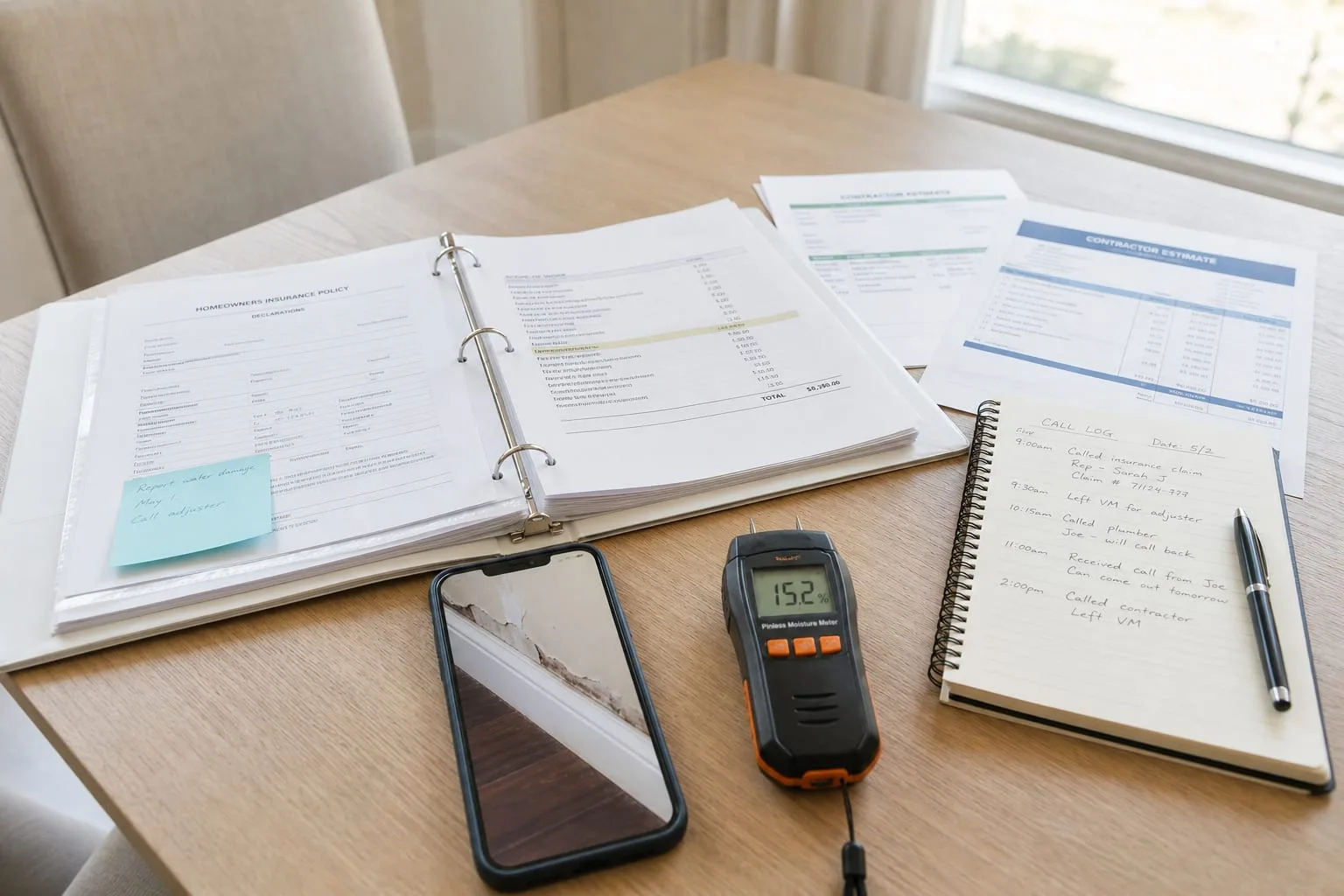
The single most useful object in a property claim is unglamorous: one folder, physical or on a laptop, that nobody else touches. It holds the declarations page, which is the two or three sheets naming your coverage limits, your deductible, and any separate percentage deductible for wind or hail. It holds the full policy wording, which is longer and duller and is the document that settles arguments. It holds the claim number, the adjuster's name, direct line and email, and the name of whoever above them handles escalation, because you will want that in week five and it is much easier to ask for in week one.
Then it holds the growing part. Every estimate you receive, including the ones you decide against, because a second contractor's number is the only leverage that reliably moves a scope of loss. Every invoice and receipt, including the small ones: the box fans, the hotel nights, the meals out while the kitchen is gone, the dehumidifier rental. Additional living expenses are a real coverage line and they are routinely underclaimed because nobody kept the parking receipts. And it holds the mitigation record, the proof that you acted promptly to stop further damage, which is a condition in most policies rather than a courtesy.
The photo log, and why timing matters more than resolution
Photographs are the one piece of documentation homeowners generally do produce, and they usually produce the wrong ones. Wide shots of a wet room, taken once, on day one. What actually carries weight is a sequence: the same corner photographed before demolition, during, and after, with something in frame for scale, and with the file timestamps intact. Photograph the back of the appliance, the failed supply line, the serial plate, the water line on the baseboard. Photograph the contents before they go in the dumpster, and write down make, model and approximate age while the object is still in front of you rather than from memory in March.
Moisture readings belong in the same log. Restoration firms take them daily on a drying job and the readings live in their software, not yours, so ask for the drying log as a document you keep. The same goes for the equipment count and the days it ran, which is often disputed later. None of this requires special tools. A phone, a notes app, and the discipline to spend ten minutes at the end of a working day is the whole apparatus, and it is the difference between remembering that a wall was soaked and being able to show it.
The week-to-week rhythm that keeps it from swallowing your life
Treat the claim as a standing appointment rather than an emergency. One hour, same day each week, with the folder open. Read whatever arrived since the last session. Send one email summarizing any phone conversation you had, in plain terms, ending with a request to correct anything you have wrong. That last habit is worth more than any argument you will ever make, because it converts a friendly verbal assurance into a written record that exists in the insurer's system as well as yours. Adjusters are not troubled by this. Organized files move faster through their queues than disorganized ones.
Keep a call log with dates, names, and what was said, and note what you were promised and by when. When the promised thing does not arrive, you are following up on a specific commitment rather than complaining generally, and the tone of the file changes accordingly. Federal involvement in property claims is narrower than people assume, though the Federal Emergency Management Agency is responsible for the national flood insurance program and flood losses follow their own documentation and proof of loss conventions, which is one more reason to establish early which policy is actually paying for what.
The households that come out of a large claim whole are not the aggressive ones or the compliant ones. They are the ones who slowed the middle of the process down while keeping the paperwork current, who read the scope of loss line by line and asked what a line item covered before agreeing to it, and who understood that a first payment is an installment on an open file. Six weeks of quiet, well-kept records will outperform six phone calls made in frustration, and it costs an hour a week to have them.