Property
Wrote the Whole Maintenance Calendar in One Sitting? The Slow Version Is the One That Survives
Household maintenance schedules fail less from laziness than from being built too fast, in a single sitting, for a year the writer has not yet lived.
PropertyBram Voskuijlen
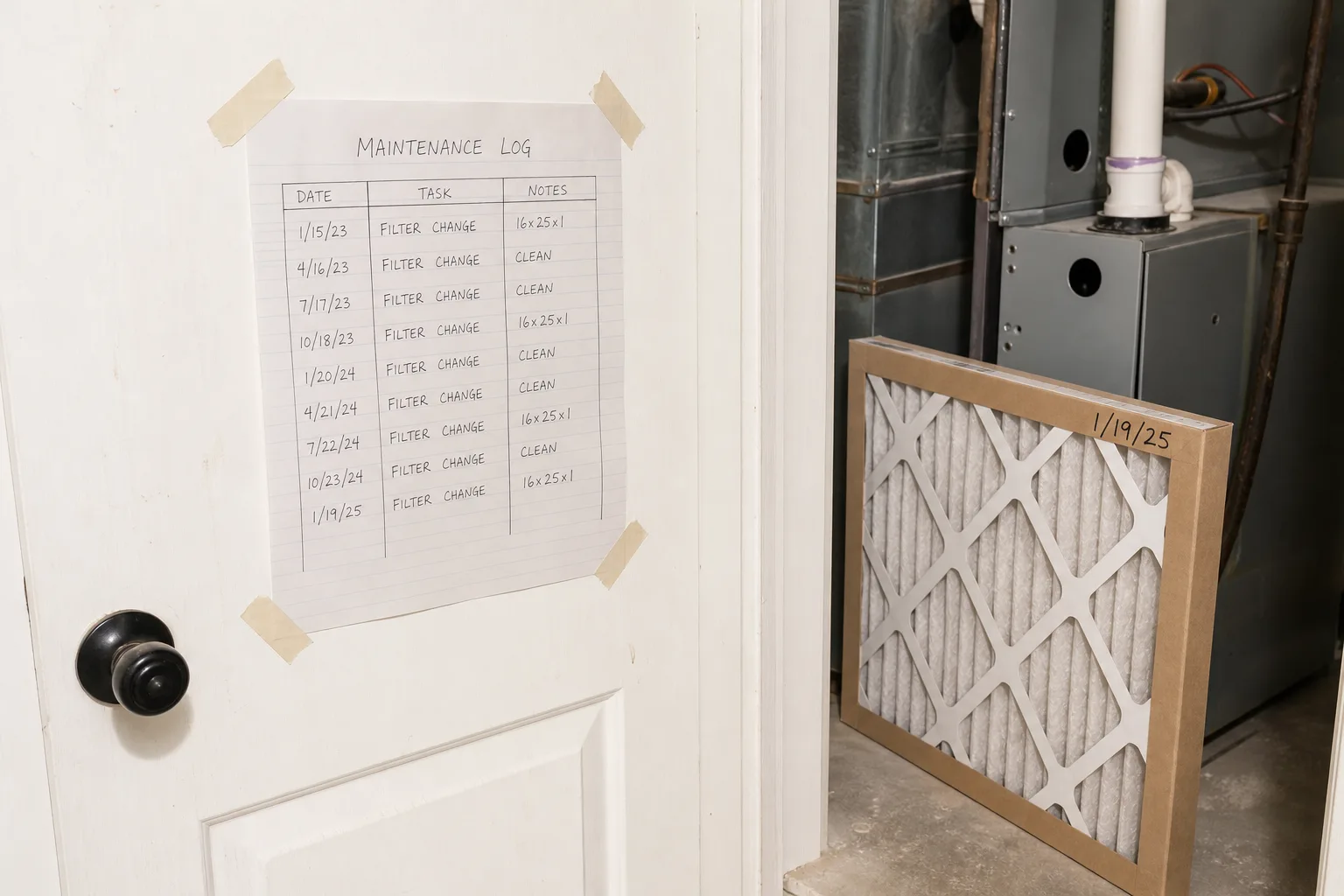
The schedule almost always gets written on a weekend, usually in January, usually after something small has gone wrong. Forty or fifty line items, color-coded by season, exported to a shared calendar with reminders set for Saturday mornings. By the second week of March it is generating notifications nobody opens, and by June the notifications have been turned off. The common diagnosis is a failure of discipline, and the common remedy is a better app. Both are wrong about what happened. The schedule failed because it was written in one sitting, about a year its author had not yet lived through.
Nobody designed the list you copied
The standard home maintenance checklist has no single author. It is a composite, assembled over decades from sources that were each solving a narrower problem. Manufacturer warranty language contributes a tier of it, because a warranty that requires annual servicing shifts a burden of proof onto the owner, and the interval chosen is conservative by design. Home inspection reports contribute another tier, written in the week of a sale by someone who will never see the house again and is professionally obliged to flag everything. Utility seasonal mailers, insurance loss-prevention bulletins, and appliance registration cards fill in the rest.
None of those sources was written with a household's whole year in view. Each one looked at a single component, estimated the interval that would keep that component out of trouble, and wrote it down without reference to the forty other items competing for the same Saturday. When an article or an app aggregates them, the aggregation inherits every conservative assumption at once. The result is a document that is individually defensible line by line and collectively impossible, which is roughly how a household ends up with a calendar that treats the gutters and the smoke detector batteries as equally urgent.
This matters because people read the composite as a standard rather than as an accumulation. Falling short of it feels like falling short of something official. It is more accurate to read it as a union of everyone's worst case, useful as a menu of candidates and misleading as a plan. The Department of Energy publishes guidance on seasonal equipment upkeep and tracks how home systems consume energy over their service lives, and that kind of guidance is genuinely worth reading, but it was written to describe a component's needs rather than a household's capacity.
What a Tuesday evening actually holds
The honest unit of household maintenance is not the Saturday morning. It is the ten minutes between putting the trash out and sitting down, and the thing that decides whether a task happens in those ten minutes is rarely how long the task takes. It is how much deciding the task requires. Changing a furnace filter takes about four minutes. Finding the filter, confirming the size, discovering the last one was the wrong depth, and establishing whether it was replaced in October or in the October before that takes considerably longer, and that is the part that gets deferred.
Tasks that survive in a real week almost all share one feature: something already happening in the house triggers them. The filter gets changed because the replacements sit in a labeled bin by the thermostat and the last date is written on the frame in marker. The dryer vent gets checked because a load took two cycles to dry and that was noticed. The water heater gets looked at because the annual service visit was scheduled by the company, not by the homeowner. In each case the prompt arrives from the environment rather than from memory or from a notification competing with everything else on a phone.
Calendar reminders work poorly here for a structural reason. They arrive at a time chosen months earlier by someone who could not know what else that Saturday would contain, and a reminder that arrives at a bad moment teaches the household to dismiss reminders. Three dismissals in, the channel is dead. A physical cue in the room where the work happens does not have that failure mode, because it is only visible when you are already standing in the right place, which is also the moment when the four minutes are actually available.
A schedule is a record before it is a plan
The case against writing the whole thing in one sitting comes down to information. In January you do not know that the north gutter fills in late November and the others do not, that the basement humidity climbs in the second week of June, that the garage door opener gets noisy in cold snaps, or that the kitchen faucet aerator clogs about twice a year because of the water. Those are the facts that make a schedule fit a specific house, and none of them can be known in advance. A plan written before the evidence exists is a guess dressed as a system.
The alternative is slower and considerably more durable. Start with a short list, no more than six or eight items, covering the things where failure is expensive and the interval is genuinely known. Then keep a running note, on paper near the panel or in one file, of everything the house actually demanded over twelve months, with the date. Not what should have been done. What was done, and what announced itself. After a year that note contains the real schedule, with intervals derived from this house rather than from the union of every manufacturer's conservative estimate.
What emerges tends to be shorter than the composite checklist and arranged differently. Items cluster. Four tasks turn out to belong to the same twenty minutes in the crawlspace, and doing them together costs barely more than doing one. Other items fall away because the evidence says they were never needed, or needed at half the frequency. A schedule built by subtraction from lived experience survives because every line on it has already proven it earns the time, which is not something a line copied from a checklist can claim.
The handful worth buying out of your own memory
Some tasks should never sit on a household schedule at all, and recognizing which ones is most of the work. The test is simple: if the consequence of missing it is measured in thousands of dollars rather than in inconvenience, the reminder should live with somebody whose business it is to send it. Annual heating and cooling service, septic pumping, chimney inspection, and backflow testing all fall in this category, and all are routinely sold on recurring terms precisely because providers know that owner-initiated scheduling fails at a predictable rate.
Consumable supply is the other candidate for outsourcing. Filters, water treatment cartridges, smoke detector batteries, and dehumidifier parts arriving on a subscription cadence convert a remembering problem into a storage problem, which households solve far more reliably. The box on the step is itself the prompt. A homeowner who has five filters in a labeled bin and a service company that calls in September has removed most of the expensive items from the calendar entirely, and what remains is small enough to be carried in an ordinary week without special effort.
That is the shape of a schedule that lasts: a few anchors handled by contract, a few consumables handled by supply, and a short, specific list of things this particular house has demonstrated it needs. It will look thinner than the version written in January, which is the point. Thin lists get read.
The January document was not wasted, incidentally. It is a useful inventory of candidates, and it is worth keeping somewhere unopened, to be consulted once a year against the running note of what the house actually did. Most of its lines will stay unused. A few will turn out to describe something real, and those can be promoted onto the short list, where they will be done, because by then there will be room.