Health
Your Billing Records Moved Into Someone Else's System. Which Ones to Pull Down, and When
Claim history now lives in portals and clearinghouses with retention windows you do not set, which changes which records a practice should hold locally and for how long.
HealthBram Voskuijlen
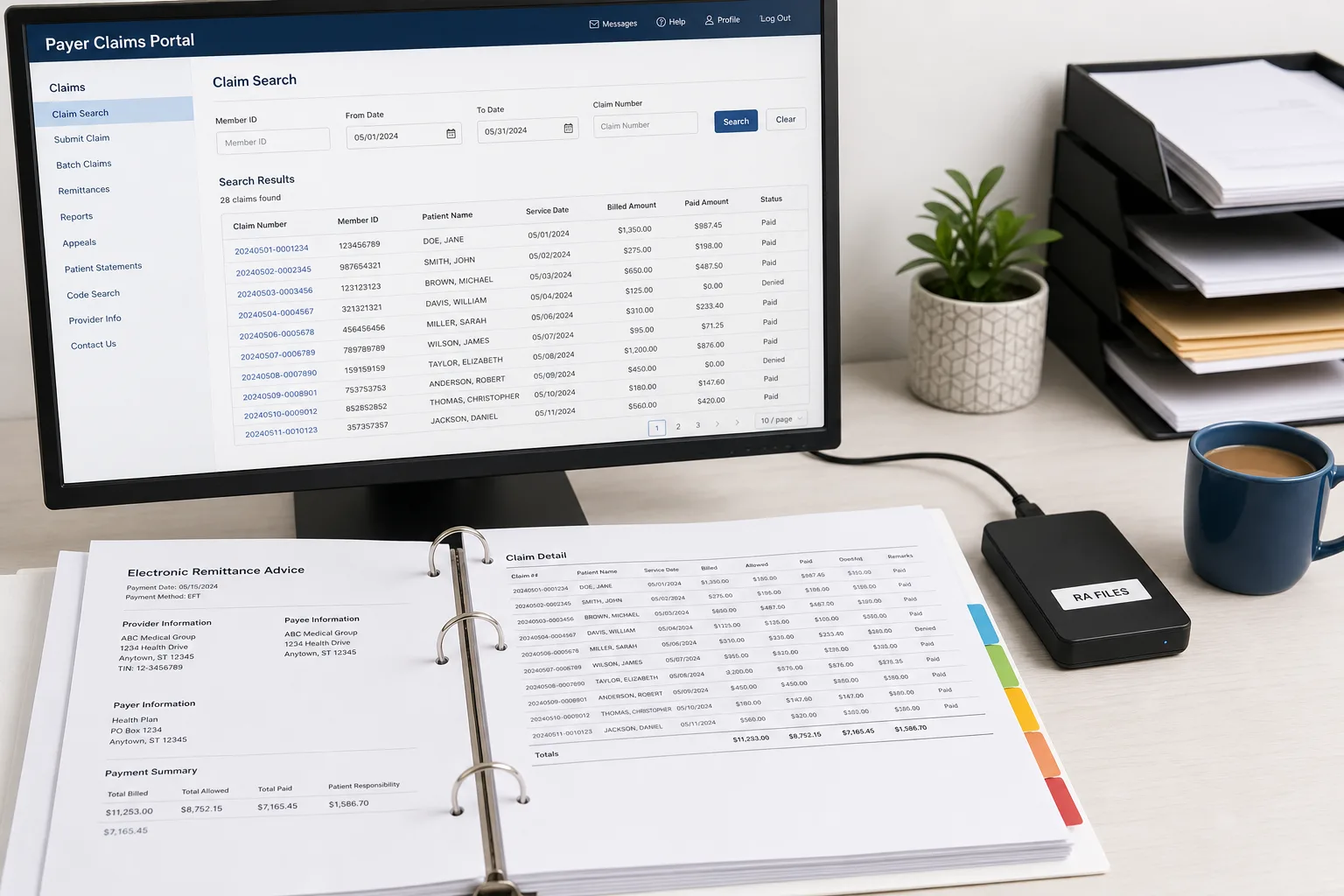
A denial that lands fourteen months after the date of service is not unusual, and it is rarely a surprise to the payer. It is a surprise to the practice, because by then the people who worked the claim have moved on, the portal that held the original acknowledgment has purged it, and the only thing left is a line in the practice management system saying the claim was submitted. Whether that denial can be overturned depends almost entirely on decisions made about record keeping long before anyone knew the denial was coming. Those decisions have become harder in a specific, recent way.
Two clocks run at the same time, and only one of them is written down
The retention schedule a practice has on paper, usually drafted by counsel or lifted from a compliance template, answers a legal question: how long must this exist in case someone with subpoena power asks for it. That clock is long, measured in years, and it is driven by audit lookback periods, the statute of limitations on false claims exposure, and state medical record law. It is also, in daily practice, almost useless as a guide to what the billing office needs, because it says nothing about which records answer the questions that actually arise.
The second clock is operational. It asks how long a given artifact can still change an outcome. A clearinghouse acceptance report is decisive for about as long as the payer's timely filing window stays open, and then it is nearly worthless. A signed payer contract with a fee schedule attached stays live for the entire term plus however long it takes to finish disputing payments made under it. A patient's eligibility screenshot from the date of service matters most in the narrow period when the payer claims coverage was not in force.
Most practices run the long clock well, because it is written down and someone audits it, and run the short clock badly, because nobody does. The gap is where appeals die. Building judgement here means learning to ask, for each kind of record, what question it would answer and who else is holding a copy that could disappear without notice.
What changed: the evidence stopped living on your premises
Ten or fifteen years ago, a denial arrived as paper, got stapled to a printout, and sat in a folder until someone threw it away. The record was poorly organized but it was unambiguously yours. Electronic remittance advice, payer web portals, and clearinghouse dashboards replaced that, and they did it in a way that quietly transferred custody. The proof that a claim was submitted on a given date, the proof that a payer acknowledged it, and often the full text of the denial rationale now sit in a system the practice licenses rather than owns.
Those systems have retention windows, and the windows have been tightening. Portals that once kept two or three years of claim history now commonly show twelve or eighteen months. Clearinghouse archives are a contract term, not a right, and they end when the contract does. Practices that switch billing vendors or clearinghouses discover this at the worst possible moment, when a post-payment audit asks for submission evidence on claims from a system they no longer have credentials to open. The record existed. Access to it did not survive.
This is the change that should reshape how a billing office thinks. The question is no longer only how long to keep something. It is whether the practice holds its own copy at all, and whether that copy is in a form a payer or an auditor will accept. Firms that provide denial management services tend to build their own parallel archive of submission and remittance evidence for exactly this reason, because they cannot appeal what they cannot document, and they have learned not to rely on anyone else's retention policy.
Comparing the four categories, and how long each stays useful
Claim transmission artifacts, meaning the 837 submission record, the clearinghouse acceptance or rejection report, and the payer acknowledgment, have a short but intense period of usefulness. They prove timeliness. Once every payer's filing and appeal deadline on that claim has closed, they revert to being audit material rather than working evidence. The practical rule most billing offices land on is to pull these down locally while the claim is open and keep the local copy as long as the long clock requires, rather than trusting the portal to still have it.
Remittance records, the electronic remittance advice and the explanation of benefits behind it, outlast the individual claim by a wide margin. They are the raw material for underpayment analysis, for proving a payer has been applying a fee schedule incorrectly across hundreds of encounters, and for reconciling against the contract. A single ERA is a transaction. A year of ERAs for one payer is an argument, and that argument only exists if the file was stored in a form that can be queried rather than as a stack of PDFs nobody can search.
Authorization and eligibility evidence occupies an awkward middle. It is captured before service, used rarely, and then needed urgently when a payer asserts that coverage or authorization was absent. A dated screenshot or a reference number recorded at the time is often the whole case. Payer contracts and fee schedules sit at the far end: they are the longest-lived records in the office, they are the hardest to reconstruct after the fact, and amendments that arrive by portal notice are the ones most often missing from the file.
Building the judgement rather than the schedule
A useful habit is to test each record against three questions before deciding its fate. What outcome could this still change, and for how long. If it vanished tomorrow, could it be reconstructed, and by whom. And does the practice hold it, or merely have a login that reaches it. Records that could change an outcome, cannot be reconstructed, and live only behind someone else's login are the ones that justify the effort of a local copy. Everything else can follow the standard schedule without much thought.
The Centers for Medicare and Medicaid Services oversees the claims and appeals framework that most commercial payers model their own processes on, which is why the structure of an appeal looks broadly similar across payers even when the deadlines differ. That similarity is worth exploiting. A practice that organizes its records around what a first-level appeal actually requires, submission proof, the remittance showing the denial reason, the clinical documentation supporting the code, and the contract language being relied on, will find it has covered most of what an audit would want as well.
The transition point worth watching is any change of vendor, clearinghouse, or practice management system. That is the moment when access quietly ends, and it is the cheapest possible time to export. Writing the export into the offboarding checklist, with a named person responsible and a defined format, converts a recurring loss into a routine task.
The records worth keeping are not the ones a template names. They are the ones that would answer a question somebody is going to ask, held in a place that does not depend on a contract staying in force. Once a billing office starts sorting by that test rather than by document type, the schedule mostly writes itself.