Property
Building Engineers Keep Short Lists. Five Checks That Make a Home Schedule Survive a Busy Month
The people who maintain hundreds of units for a living build schedules that survive interruption, and their habits translate directly to a single house.
PropertyBram Voskuijlen
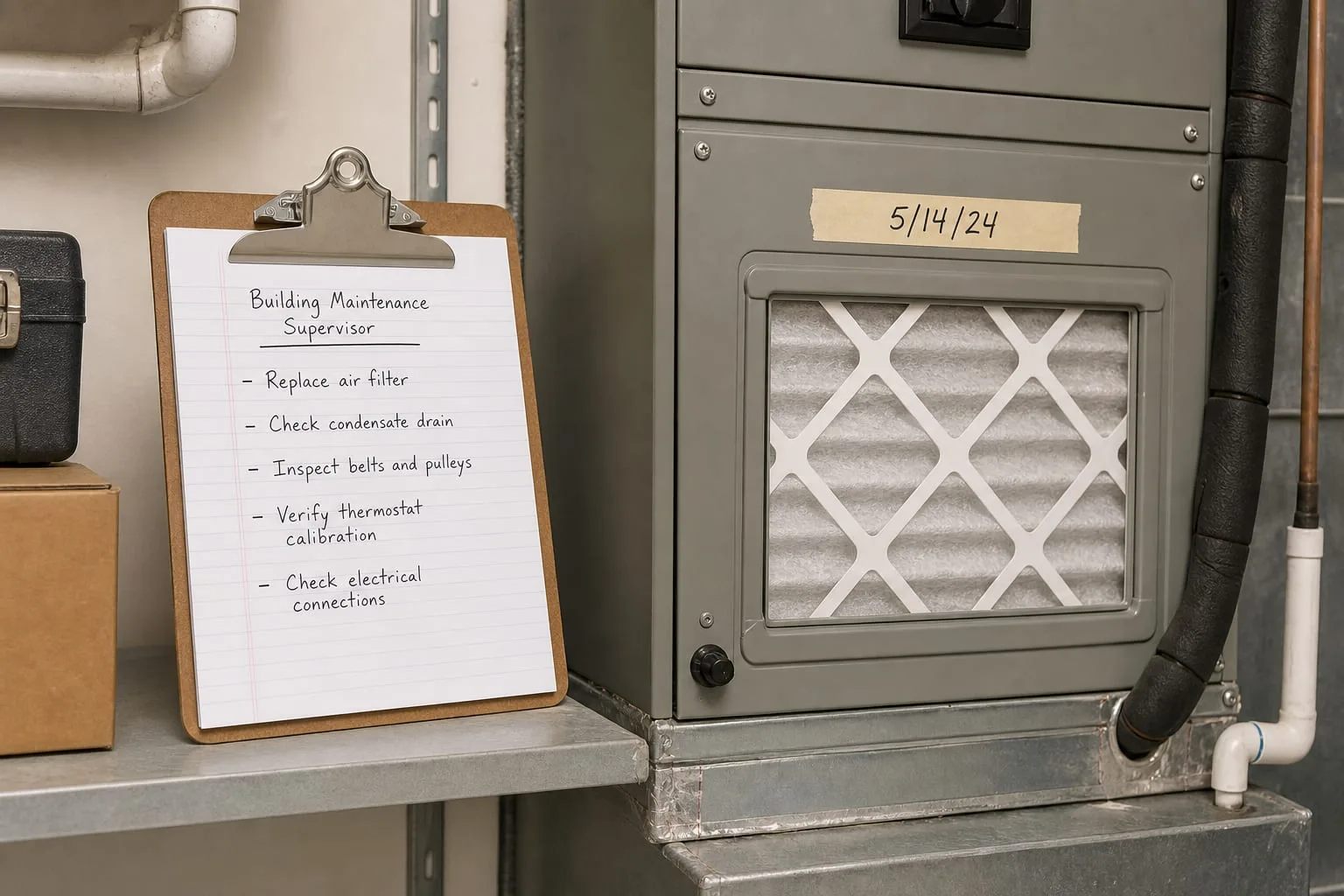
The printable home maintenance calendar is a genre of its own, and almost all of them are written by people who have never had to keep one for a hundred and forty units with two staff and a snow event in the middle of February. The people who do that for a living build schedules differently. They assume interruption, they assume the person doing the work will be someone else in three years, and they assume nobody remembers anything. What follows are five things to look for in a schedule before you commit to it, drawn from how that work is actually organized rather than how the seasonal checklist imagines it.
1. Does each task hang on an event, or on a date?
A route sheet in commercial janitorial work does not say the fifteenth of the month. It says after the last shift Friday, or when the bin is swapped. Dates fail because they compete with everything else on the date; events do not compete, because they are already going to happen. A schedule worth keeping ties the furnace filter to the electric bill arriving, the water heater flush to the week you switch the clocks, the dryer vent to the last load before a holiday when the house fills up. Apartment maintenance supervisors call this anchoring, and it is the single change that converts a schedule from aspiration into something that gets done while you are already standing there.
2. How many items does a season actually carry?
The published seasonal lists tend to run twenty or thirty items per quarter, and the maintenance techs who see hundreds of units a year run something closer to six. That is not laziness. It is triage learned from watching which neglected items generate emergency calls and which generate nothing at all in a decade. When you read a schedule, count the fall column. If it is long enough that you would need a free Saturday to clear it, you will not clear it, and the failure will be general rather than selective: you will skip the whole column, including the two items that mattered. Ask instead which four things on the list, left undone for two years, would cost real money, and build the season around those.
3. Is each line a chore or a phone call?
Building engineers separate work into what they do and what they schedule a vendor for, and they never mix the two on one sheet, because the lead times are different. A homeowner's schedule should make the same split visible. Cleaning the refrigerator condenser coil is a chore, twenty minutes and a brush. Getting a technician to look at a heat pump before the first cold snap is a phone call, and one placed in September rather than November, because the people who take that call are booking three weeks out by the time the temperature drops. A schedule that treats both as identical tasks tends to leave the vendor items until the vendor is unavailable, which is how a maintenance item becomes a repair.
4. Can you tell whether it was done without remembering?
The maintenance trades solved this a long time ago with dated tape and a paper log zip-tied to the unit. A filter with the install date written on the cardboard edge in marker answers the question in two seconds, in the dark, from a step stool. A water heater with a strip of masking tape recording each flush answers it years later, for a buyer's inspector as well as for you. This matters more than it sounds, because the most common failure in a household schedule is not skipping a task but losing track of whether the task happened, then either doing it twice or, more often, deferring it indefinitely while assuming somebody must have. Verification lives on the equipment, not in an app.
5. Does the schedule say what happens when an item slips?
Every experienced maintenance planner ranks work by the cost of lateness, not by frequency. Some items are elastic: a month late on cleaning bathroom exhaust grilles costs nothing measurable. Some are not: a sump pump untested going into a wet spring, a gutter left packed above a finished basement, a filter so loaded that the air handler starves. The Department of Energy oversees efficiency standards for the heating and cooling equipment where most of that consequence sits, and the practical version for a household is a schedule that marks two or three lines as the ones you do not slide. Everything else can move a few weeks without anyone paying for it, and knowing which is which is what keeps the whole thing from collapsing when a month goes sideways.
What the trade version looks like on paper
Six items a season, each attached to something already on the calendar, split between chores and calls, verified with tape on the equipment, with two lines flagged as non-negotiable. It fits on an index card. That is roughly what a good maintenance supervisor carries for a building far larger and more complicated than a house, and the reason it works is that it was written by someone expecting to be interrupted rather than someone expecting to be diligent.
If your current schedule is a printed twelve-month grid with thirty boxes a quarter, you have not failed to keep it. You were handed a document built for a reader who does not exist, and the fix is subtraction, an index card, and a marker.