Family
Burying Someone in January? Which Winter Charges Are Real and Which Are Optional
Cold-weather burials add line items that do not appear in summer. Which ones the cemetery genuinely imposes, which the funeral home controls, and which a family can decline outright.
FamilyBram Voskuijlen
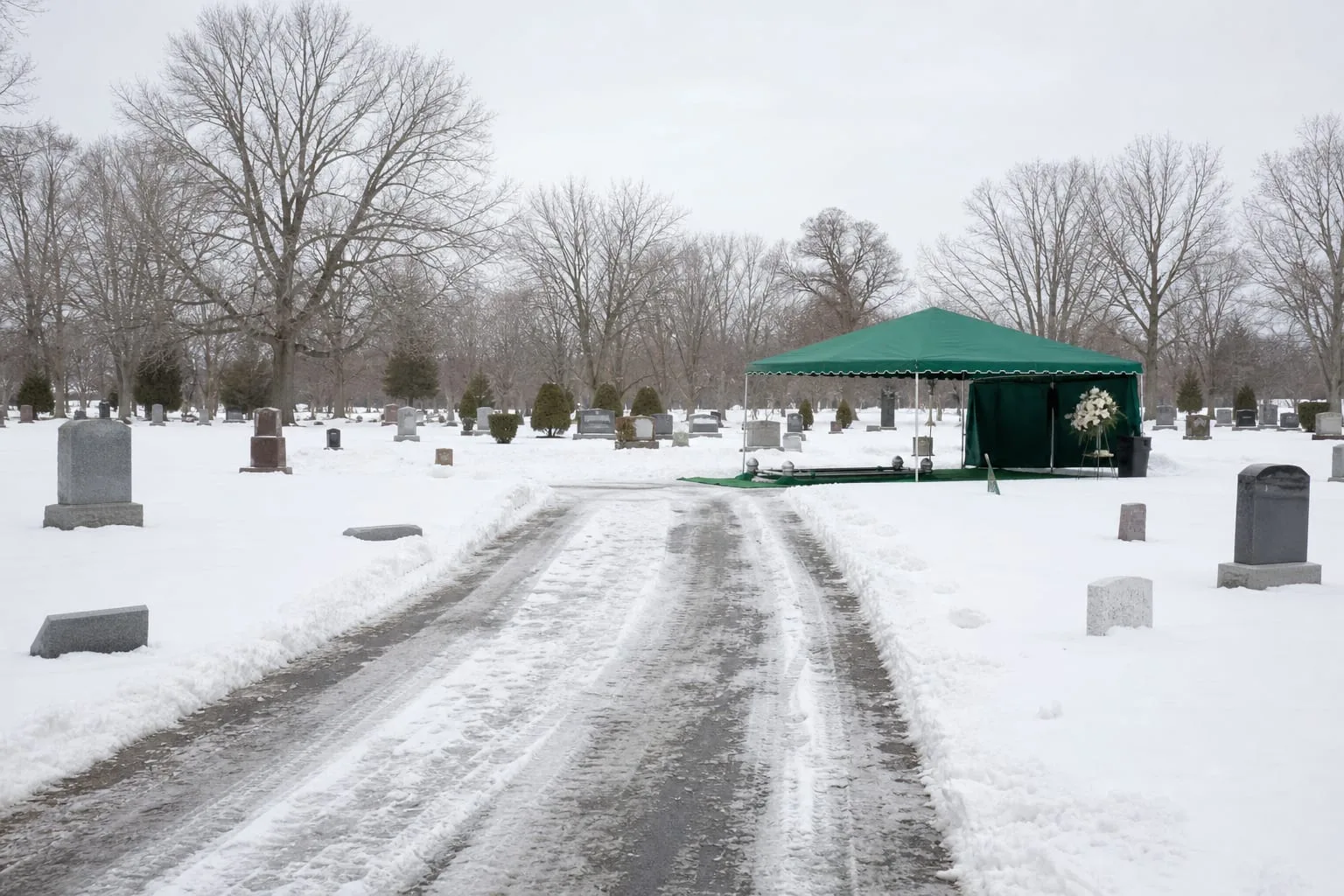
A death in the second week of January produces a bill that looks different from the same death in July, and most families discover this at the arrangement conference, sitting across a desk, three days in, with no appetite for arguing about a backhoe. The differences are real. Some of them are also entirely avoidable, and the distinction is not obvious from the paperwork, because winter charges arrive mixed together with charges that would appear in any month. Sorting them takes about twenty minutes if you know which questions produce a useful answer. Below is what actually changes between seasons, and who controls each piece.
The charges that exist only because the ground is frozen
Grave opening and closing is a cemetery charge, not a funeral home charge, and in cold-weather states many cemeteries publish a separate winter rate or add a frost surcharge between roughly December and March. The reason is mechanical: frozen ground has to be broken with different equipment, sometimes thawed first, and the work takes longer. A second cold-weather item is site access, meaning snow clearing along the drive and around the grave so a hearse and a procession can reach it. Neither of these is negotiable in any meaningful sense. What is negotiable is whether you learn about them before or after you have committed to a plot, a date, and a casket, and a funeral director who volunteers the cemetery's winter schedule without being asked is doing the job properly.
The graveside equipment is a different category. A tent, sidewalls, and propane heaters are usually rented, often through the funeral home, and they are billed to you as a service or as a cash advance. Families order them because standing in wind for fifteen minutes is genuinely hard on elderly mourners. Families also decline them, hold a two-minute committal, and go inside. Both are defensible. The point is that the tent is a comfort purchase and the frost surcharge is not, and they should never be presented as a single winter package.
Waiting until spring, and what the delay actually costs
Deferring burial until the ground reopens is common, quietly common, and nobody in the industry treats it as unusual. Some cemeteries in northern states essentially require it. The version families are told about involves a holding fee, sometimes called winter storage or a receiving vault charge, billed monthly or as a flat seasonal amount. The version families work out later is that deferral splits one event into two: a service in January with the people who can travel in January, and a committal in April with a smaller group and a second round of travel. That second gathering carries its own costs, and it also carries something worth having, which is time. Choosing a headstone in April, with the estate sorted and the shock past, produces better decisions than choosing one on day three.
Cremation changes the arithmetic here rather than removing it. The remains can be held at no meaningful cost, so the deferral is nearly free, and the spring gathering becomes a scheduling question rather than a financial one. Families who want a burial plot and a marker but do not want a January graveside service often land here, and the funeral homes that handle it well say so early instead of waiting to be asked.
Reading the winter quote against the general price list
The Federal Trade Commission is responsible for the rule that governs how funeral providers disclose prices, and the practical effect for a household is that you are entitled to an itemized general price list, on paper, before you agree to anything, and you are entitled to buy individual items rather than a package. Use that. Ask the director to mark which lines on the quote are the funeral home's own charges and which are cash advances passed through to a third party, typically the cemetery, the crematory, the florist, the clergy, and the newspaper. Cash advance items are where the seasonal variation hides, because the funeral home is repeating a number someone else set and has no particular reason to explain it.
A good arrangement conference produces a sheet where the cemetery's opening fee, its winter surcharge, and the tent rental are three separate lines with three separate numbers. A barely adequate one produces a single winter services figure. The difference costs the family nothing to insist on, and it is the single most reliable signal of how the rest of the engagement will go.
The seasonal costs that are purely elective
Flowers move with the calendar, and a funeral falling near Valentine's Day, Mother's Day, or the December holidays competes with retail demand for exactly the same stems. Casket sprays are priced accordingly. Families cut this by choosing whatever the florist has in volume that week rather than a specified arrangement, by using a single piece instead of three, or by asking for donations to a charity in place of flowers, which most obituary templates already accommodate.
Travel is the larger seasonal number and it lands on the guests rather than the estate. Winter airfare around the holidays, weather cancellations, and a hotel block booked in a hurry mean that scheduling a service four days out versus ten days out can move thousands of dollars across an extended family. That is a real cost even though it never appears on the funeral home's invoice, and it is the strongest practical argument for a later date. Nothing about a delayed service is disrespectful, whatever the family member who says otherwise believes.
Reception costs follow the same logic. A January gathering needs an indoor room, which usually means renting one or using a church hall, where a June gathering can spill into a yard. Catering a room is a choice, and plenty of families do it with a coffee urn and food that arrived at the house anyway.
The useful frame is not summer versus winter but fixed versus elective. Frozen-ground work, snow clearing, and the cemetery's own schedule are fixed, and the tent, the flowers, the reception, the timing, and whether the burial happens this month or in April are all yours to set. A funeral home that draws that line for you before you ask has told you most of what you need to know about it.