Education
Choosing a Course? The Hours Nobody Publishes Decide Whether You Finish
Tuition and completion rates are easy to find. The weekday hours a program quietly demands are not, and they decide more enrollments than price does.
EducationYolanda Escamilla
Ten years ago, comparing two training programs meant collecting paper. You called a number during business hours, left a message, and waited two days for a return call from an admissions counselor who read you the start dates. You drove to an information session held at seven on a Tuesday, took a folder home, and made a decision on the strength of a conversation. The cost of looking was measured in gas and evenings. What you got back was thin on data and surprisingly rich on logistics, because the person talking to you had actually walked the building.
Now the looking is nearly free and the logistics have gone quiet. That trade is the whole problem, and it is fixable once you know which questions were lost.
What got easier, and what the dashboard stopped telling you
The published side of this decision has improved enormously. Tuition, fees, typical borrowing, completion rates and post-program earnings are now searchable in an afternoon, often side by side, and the Department of Education oversees much of the reporting that makes those comparisons possible. You can apply at eleven at night, upload a transcript from your phone, and track a decision in a portal. Ten years of work went into closing the information gap on price and outcomes, and it largely closed. None of those numbers tell you when you have to be somewhere.
That is the gap that opened in the same decade. The old information night produced an offhand remark that organized your year: the second-semester lab only runs Tuesday and Thursday mornings, the clinical rotation is day shift for six weeks, the externship coordinator places students in a county forty minutes out. A chatbot will not volunteer any of it. A portal has no reason to. The published figures assume a student with an open calendar, and most adult students do not have one.
Read the schedule as a bill in hours
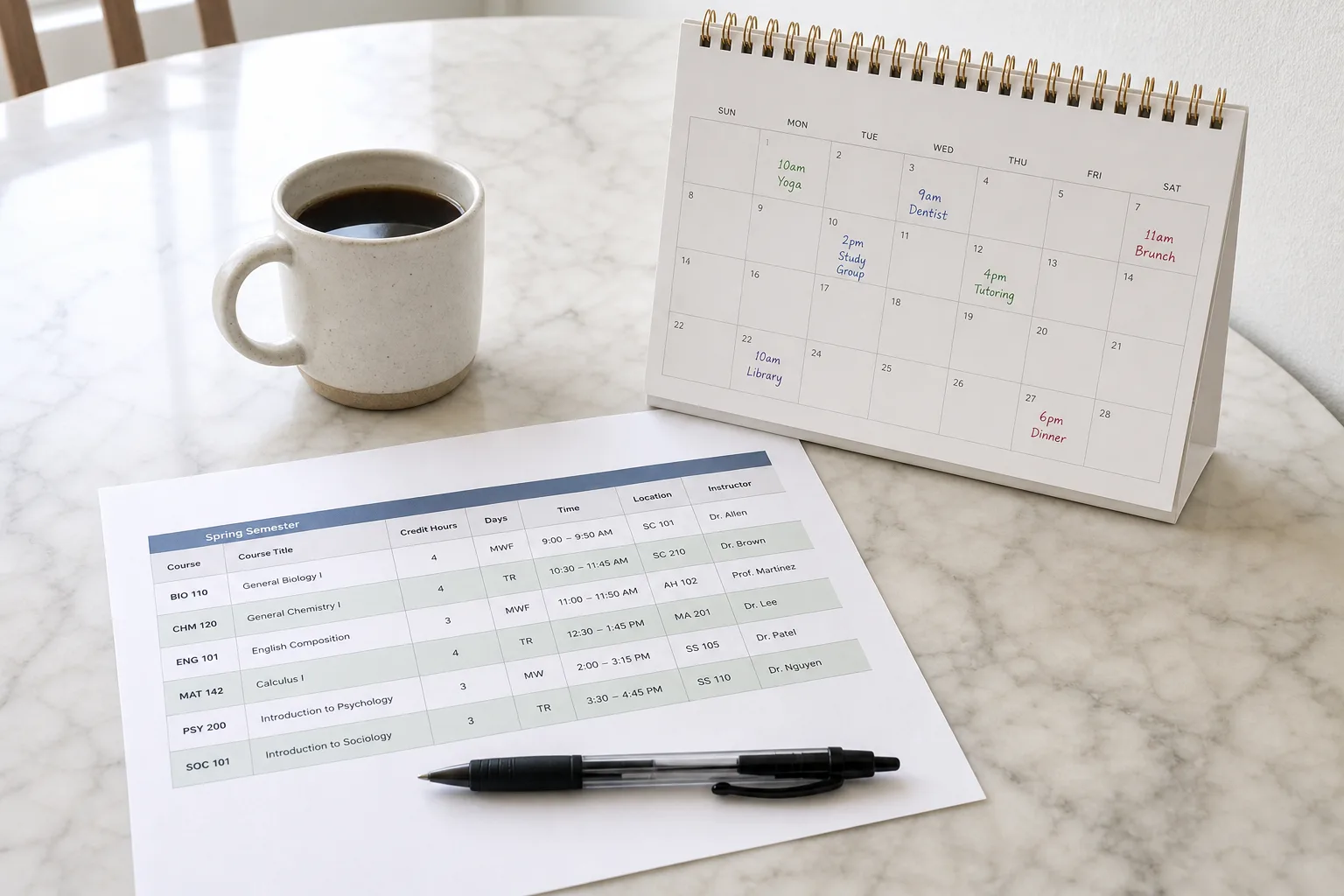
Before the money, price the time. Take the program's own course sequence and write down, term by term, the contact hours and when they fall. Online programs split into two kinds that catalogs describe with the same word: asynchronous work you do at midnight, and synchronous sessions that meet at a fixed hour on a fixed weekday. A program listed as online can still require you to be logged in and talking at ten on a Wednesday morning. That single detail decides whether the program is compatible with a job, and it is rarely on the comparison page.
Then add the hours that are not classes. Licensure programs in health, trades and early education carry supervised hours served on someone else's schedule, in places assigned to you rather than chosen by you. Ask how many hours, over how many weeks, during which shifts, and how far the typical placement sits from campus. Add the mandatory orientation, the proctored exams that must be taken at a testing center during business hours, the background check appointment, the immunization visit, the fitting for whatever uniform or boots the program requires. These are small individually. Together they are a part-time job.
The number that is never published is how often a required course runs
Completion rates are reported as a share of students who finish. They are not reported as a calendar, and the calendar is usually what stretches. A required course offered once a year, in one section, at one time, converts a single scheduling conflict into a twelve-month delay. A prerequisite chain three courses deep means a missed fall start costs you the following spring as well. Students who take longer than the advertised length are often not struggling academically; they lost a seat and waited.
Ask the registrar's office, not admissions, how many sections of each required course ran in the last two academic years and what the waitlist looked like at registration. Ask whether enrolled students register before or after a priority group, because that ordering decides who gets the one convenient section. Ask what happens when a course fills: is there an overload process, a second section added, a faculty member with discretion? A program that answers those questions precisely is telling you something real about how it is run.
Get the answers from people who keep the calendar
Admissions staff are measured on enrollments and are often several steps removed from the schedule. The people who know are the program coordinator, the clinical or externship placement office, and the department's administrative assistant, who in my experience knows exactly which section fills first and why. Email all three with four short, concrete questions rather than a general request for information. Ask for the actual term-by-term schedule from the current cohort, not the catalog version. Ask what time of day placements run. Ask the completion time for students who work full time.
Then talk to two students who are halfway through, which is far easier now than it was ten years ago because program pages, alumni groups and public forums put you one message away from someone with no stake in your decision. Ask them what they had to rearrange, how many weekday appointments the first term required, and what they would have scheduled differently. Ask whether anything was moved mid-term. You are buying a year of weekday mornings as surely as you are buying instruction, and the people living that year will price it for you honestly.
The published numbers answer whether the program is worth the money. The schedule answers whether you can actually be there, and that question is now the one you have to go get yourself. It takes about a week of emails and two phone calls, which is a small price for knowing, before you pay a deposit, exactly which mornings of your life the next two years will claim.