Property
Cloudy Glasses and a Second Wash Cycle? The Ten Minute Job Nobody Files Under Maintenance
Most household maintenance schedules fail because they arrive complete. One dishwasher filter shows why a task earns its place by being traced back from a symptom you already live with.
PropertyBram Voskuijlen
The printed seasonal maintenance checklist is one of the most reliably abandoned documents in American domestic life. It arrives complete, forty or sixty items deep, sorted by quarter, and it assumes a household that has decided in advance to care about all of it equally. Real households do not work that way. They notice a symptom, live with it for a while, invent a workaround, and eventually replace something. The argument for going slowly is not about discipline or virtue: a schedule assembled one task at a time, each earned by a consequence somebody actually noticed, survives contact with an ordinary week in a way the complete version never does.
The complaint gets filed against the detergent, not the machine
Consider a narrow case. Glasses come out of the dishwasher with a fine haze on them, plates have a gritty film near the rim, and a coffee mug that went in dirty comes out dirty in the same place. Almost nobody records this as a maintenance failure. It gets recorded as a detergent problem, so the household switches brands, then adds rinse aid, then tries the pods with the blue center, then concludes that the water is hard and buys a softener additive. Somewhere in that sequence the machine acquires a reputation for being bad at its job.
What follows is the workaround, and the workaround is the expensive part. People start rinsing dishes at the sink before loading, which takes several minutes per meal and undoes most of the water savings the appliance was bought for. They run the heavy cycle by default. They rewash a load of glasses. They stop putting anything they care about in there at all, which quietly converts a dishwasher into a drying rack with a door. None of these decisions feels like a decision. Each one is a small accommodation made in the ninety seconds after opening the machine, and together they cost more per year than the repair ever would.
What is actually sitting at the bottom of the tub
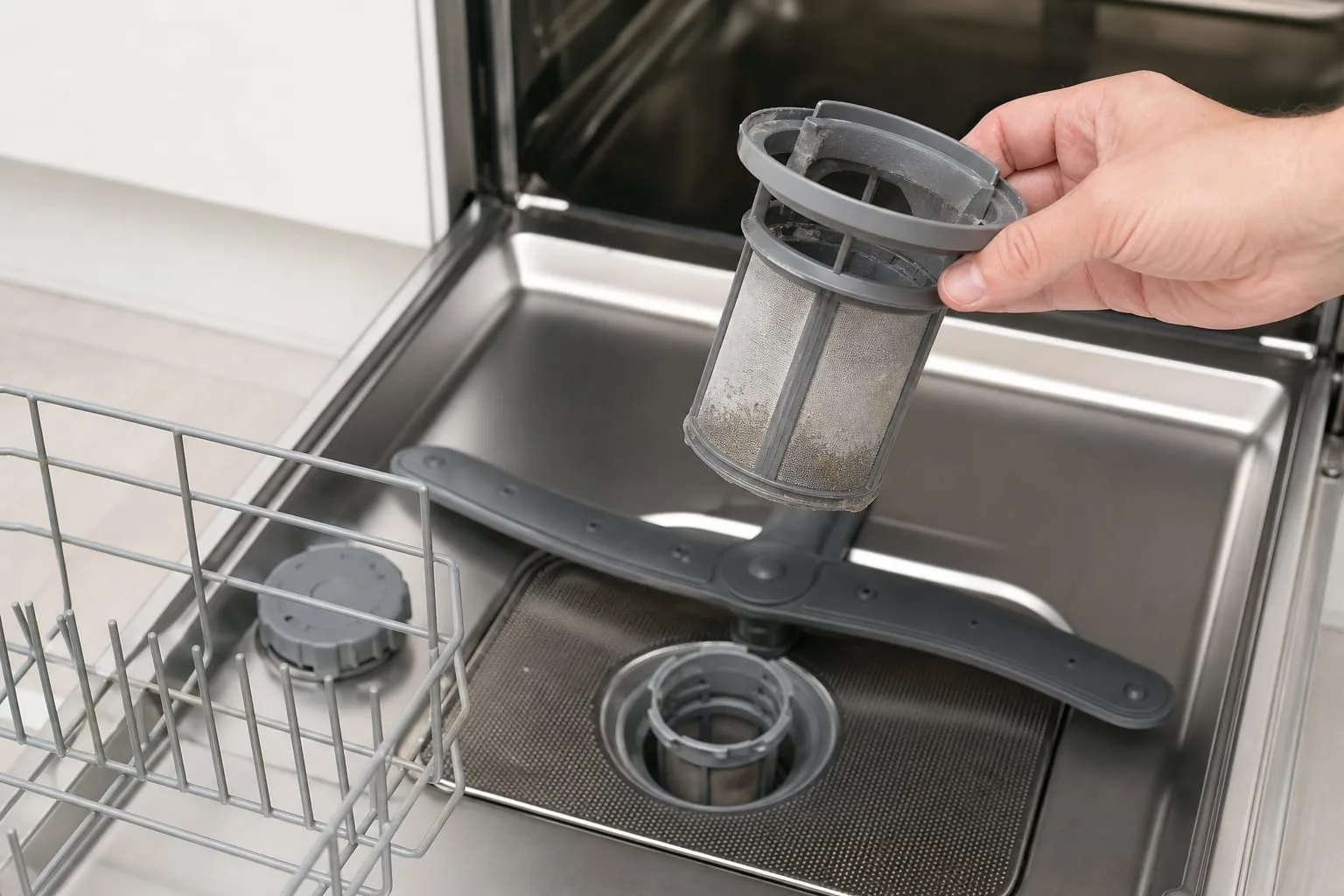
Most dishwashers sold in the last fifteen years or so use a filter rather than a hard food grinder, which is why they are dramatically quieter than the machines people remember from childhood, and why they need attention the old ones did not. There is a cylindrical filter that twists out of the sump, usually a quarter turn, and beneath it a flat coarse screen that lifts away. Food debris collects there. When the filter loads up, the pump recirculates water through a slurry of what came off the last four loads, and that slurry is what dries onto the glasses as haze. The machine is working exactly as designed. It is simply washing with dirty water.
The job takes about ten minutes, and it does not require tools. Twist the filter out, run it under the faucet, use an old toothbrush on the mesh, lift the coarse screen and wipe the sump underneath it, then check the spray arm holes for the small seeds and chips of label paper that block them. Fit the filter back and turn it until it seats, because a filter left loose lets debris bypass into the pump, which is the one failure in this chain that involves a service call. Quarterly is a reasonable interval for a household that cooks; monthly if you skip rinsing entirely.
Why the trigger outperforms the calendar
Here is where the case against rushing becomes practical rather than philosophical. If cleaning the filter enters your life as item thirty-one on a downloaded spring checklist, it competes for attention with gutter guards, dryer vents, water heater flushing, and caulking the tub, and it loses, because nothing about it feels urgent on the day you read the list. If it enters your life the afternoon you pull out a hazy glass and finally connect the haze to the sump, it arrives attached to a consequence you have personally been annoyed by. That attachment is what makes it stick. The task is not more important than the other thirty; it is better anchored.
Anchoring works best when the trigger is something you already do. Filter cleaning fits naturally on the evening you run out of dishwasher pods and open the new box, or the first weekend of a season, or the day after a holiday meal when the machine has processed more food waste than usual. A date on a calendar app asks you to interrupt your week. A trigger asks you to extend something you are already standing in front of. Households that keep any maintenance at all tend to keep the version that is bolted to an existing habit, and they tend to abandon the version that requires a fresh act of will.
The consequences that never get traced back
The reason this particular case is worth setting out in full is that its consequences are all deniable. Nobody attributes a slightly higher water bill to a clogged screen, and nobody itemizes the twenty minutes a week spent prewashing. The Department of Energy oversees appliance efficiency standards and testing for machines like these, and the ratings on the sticker assume a dishwasher that is filtering properly and being run without a hand rinse first. A neglected filter does not show up as a broken appliance. It shows up as a household that has decided, without ever saying so, that dishwashers do not really work.
The endpoint is replacement. A machine that has been washing with recirculated debris for four years gets described as worn out, and it gets replaced with a new one that will begin the same slow decline within eighteen months, because nothing about the household's habits changed in the purchase. That is a substantial expense produced entirely by an untraced symptom. Tracing it back once, and then attaching the fix to something you already do every few months, is the whole intervention. It is not impressive, and it does not fill a checklist.
Build the schedule this way and it grows slowly, three or four items a year, each one arriving with a story about the thing it fixed. That schedule is short, unbalanced, missing items a professional would include, and still in use two years later, which is more than can be said for the complete one.