Family
A Companion Marker With One Date Blank, and the Work That Happens Thirty Years Later
A bronze companion marker is cast, not carved, and the second date is a separate manufacturing job that a family often orders decades after the first.
FamilyBram Voskuijlen
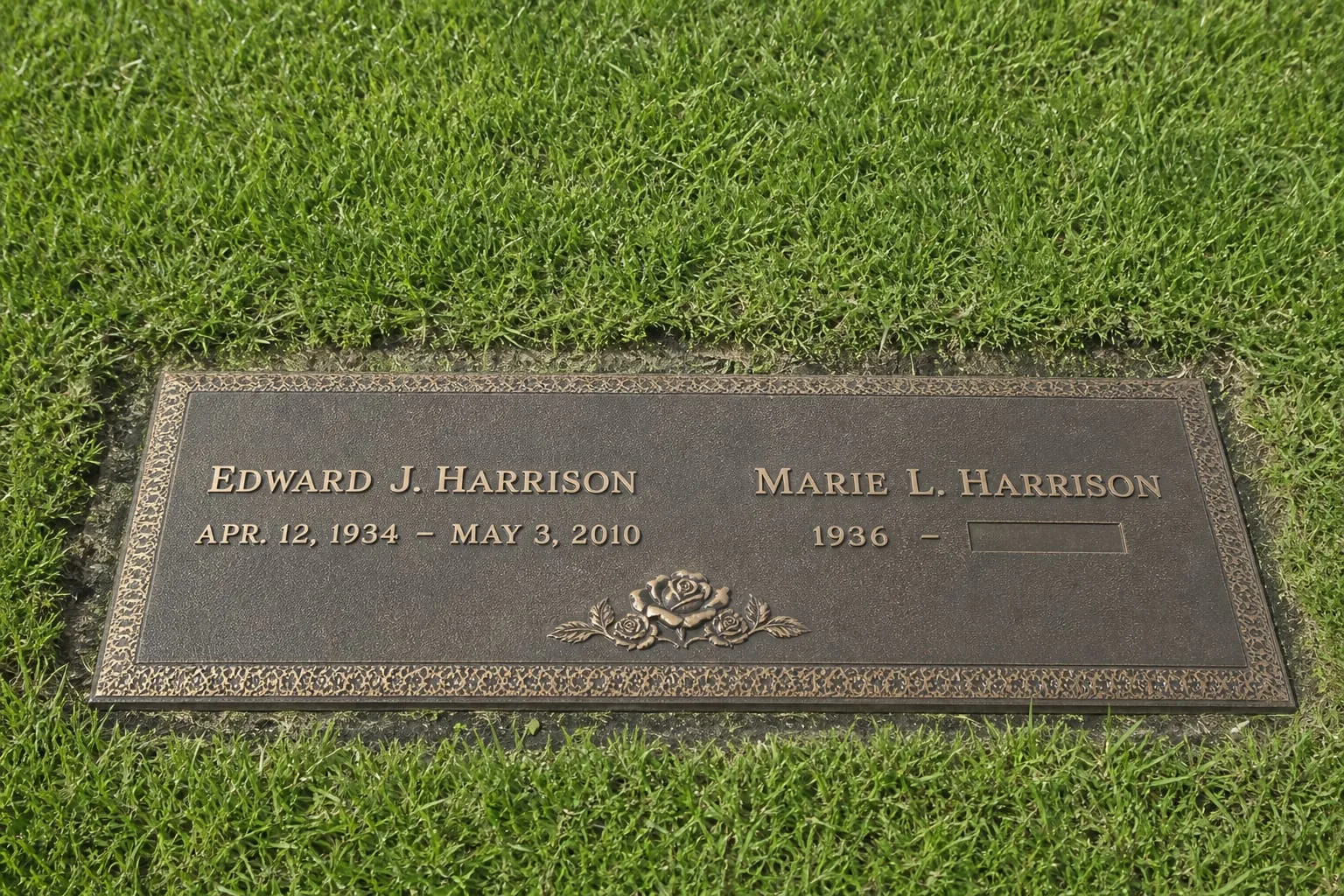
A couple buys two graves in the lawn section of a suburban cemetery, and orders one bronze plate with both names on it. His dates are complete. Hers show a birth year and then nothing, because she is standing there while the order is signed. The salesperson calls this a companion marker and says the second date can be added later, which is true, and says it in a tone that suggests the adding is a small clerical matter, which is not. Thirty years can pass between those two events. Almost everything that makes the second date easy or hard is decided at the first order.
How the flush bronze marker became the default in the first place
Before the memorial park movement, cemeteries were vertical: upright granite, marble tablets, ledger stones, family obelisks, each set by a monument dealer the family hired directly. The lawn-park model that spread through American cemeteries in the first half of the twentieth century inverted that arrangement, selling an unbroken sweep of grass as the product and treating the marker as something that should not interrupt it. The economics were maintenance economics. A crew can run a mower straight over a flush bronze plate set on a concrete base, and cannot run one around four hundred upright stones without hand trimming every week of the growing season.
Perpetual care funds made that arithmetic binding rather than aesthetic. When a cemetery takes a portion of each sale into a trust and promises grounds upkeep in return, the cost of mowing a section for the next century becomes a number on its own books, and the rules about what may be installed in that section become the mechanism for controlling it. Bronze also suited the seller. A cast plate is a manufactured good with a catalog, a set of standard sizes, an ordering deadline and a margin, rather than a piece of custom stonework negotiated between a family and an independent carver.
So the flush bronze marker is not a style choice that happened to win. It is the artifact of a maintenance model, and the reason a family standing in a lawn section is usually offered bronze in three sizes rather than granite in any shape is that the section was designed and priced around bronze before anyone in the family was born.
Cast, not carved, and what that means for a blank date
The distinction people miss is that bronze letters are not cut into the plate. A pattern is made, a mold is taken, the metal is poured, and the letters exist because the mold had spaces where letters should be. Nothing is removed from a finished bronze marker. That is why a monument dealer can send a granite tablet back to the shop and have a new date sandblasted into the stone in an afternoon, and why the same request on a bronze plate is a manufacturing job that starts over from a pattern. The material determines the procedure, and the procedure determines the price.
Foundries solved this decades ago with two workarounds, and both of them have to be chosen at the original order. The first is a raised date scroll or emblem, a small separate bronze piece cast with the second date and mechanically fastened into a recess that was designed into the plate from the beginning. The second is a companion plate layout that leaves the death area on a removable insert. If neither was specified, the remaining route is to pull the marker, ship it back, and have the whole thing recast or a section cut and welded, which is real metalwork and priced accordingly.
The recess is the decision that cannot be reversed later. A plate cast without one has no place to take a date scroll, and adding a mounting point to finished bronze in the field is not something a reputable foundry will do. The good news is that asking for it costs almost nothing at the point of order, and most manufacturers offer it as a standard option on any companion layout. A family that says the word aloud at the desk, and gets it written on the order form, has converted a future foundry job into a future service call.
The narrow case: the order nobody places
Follow one plate through. Husband dies, marker ordered and set, wife lives another twenty-eight years and dies in a different state near an adult child. The funeral is handled locally, the burial is a shipment back to the original cemetery, and the second date is on nobody's checklist because the funeral home that arranged the service never sold the marker and the cemetery that opens the grave does not manufacture anything. Cemeteries generally do not chase families for this. The grave is filled, the account is settled, and the plate sits there with an open date until a grandchild notices it at a graveside visit years later.
When someone finally does place the order, four things have moved. The foundry may have discontinued the border and lettering style, so a matching date scroll has to be made from a photograph and a measurement. The bronze on the plate has thirty years of patina and a replacement piece will not match it until it weathers. The cemetery has a current setting fee and a current rule about who may remove a marker from a grave, which is nearly always its own staff and nobody else's. And the person paying is a generation removed from the original purchase, working from a file that may or may not include the original order number.
That order number is the whole game. With it, a foundry can pull the specification and reproduce the typeface, the border, the emblem and the alloy without guesswork, and the job becomes a routine reorder. Without it, someone measures the plate with a tape, photographs it in flat light, and a pattern maker approximates. Families who keep the paperwork, and specifically who scan the marker order form and the cemetery's interment record into the same folder as the deed to the plot, hand the next generation a twenty minute phone call instead of an investigation.
What is worth settling at the desk, and what genuinely can wait
Price disclosure in this corner of the industry is uneven, and it helps to know why. The Federal Trade Commission is responsible for the rules governing how funeral providers itemize and disclose the goods and services they sell, and those rules were written with funeral homes in mind. Cemeteries and monument dealers occupy a different position, and a family shopping for a marker is often reading a catalog rather than a required price list. The practical answer is to ask for the marker order as a written specification with a line for every option, including the vase, the emblem, the recess and the second date provision, before any signature.
Some choices genuinely can wait. Flower vases can usually be added later if the plate was cast with the threaded boss, epitaph lines below the names can sometimes be handled on a separate small plaque where the cemetery allows one, and the cemetery's own setting work is priced when it happens rather than years in advance. What cannot wait is anything that changes the mold: the size, the border, the lettering, the layout of the name block, and the recess that a date scroll will eventually need. Those exist or they do not, and the pour settles it.
A companion marker is one object doing two jobs decades apart, and the second job goes smoothly in almost exact proportion to how specific the first order was. Ask for the recess, keep the order number, and tell whoever will handle the second death where the folder is.