Property
Drying Properly or Just Drying Fast? How to Tell Which One Your Crew Is Doing
Two crews can run the same equipment for the same three days and reach different results. What separates them is how they define dry, and where they work.
PropertyBram Voskuijlen
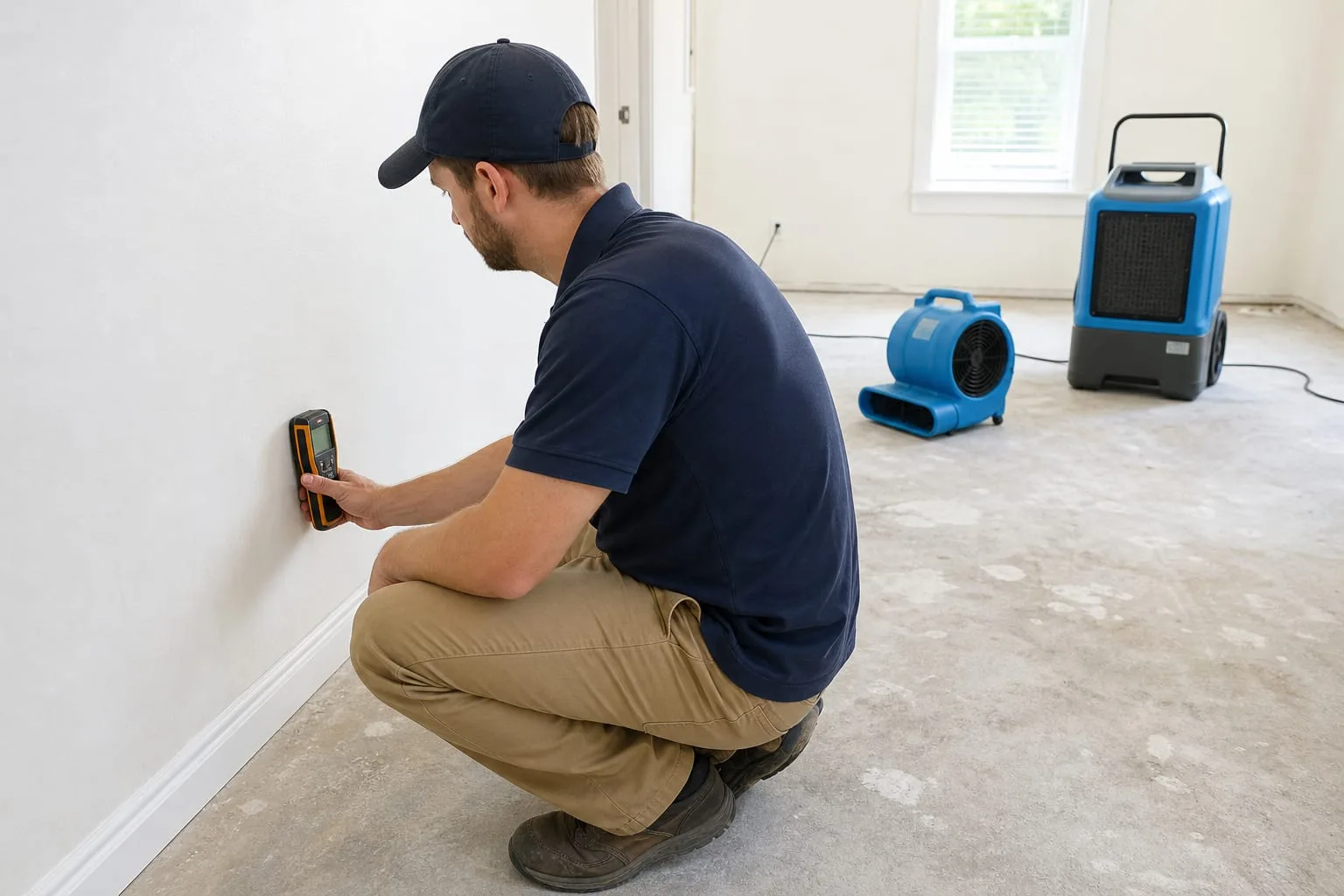
The fans arrive, the air movers point at the baseboards, and by the third morning the carpet feels fine underfoot. That is the point at which most homeowners stop asking questions, and it is also the point at which the two possible versions of the job diverge. One crew is drying the building. The other is drying the surfaces you can touch, which is faster, cheaper, and looks identical from the hallway. Telling them apart does not require equipment or a certification. It requires knowing what a competent operator would be measuring, and asking to see it.
Dry is a comparison, not a feeling
A restoration technician working properly does not decide a wall is dry because it stopped feeling damp. He establishes a dry standard by taking readings from material of the same type in an area the water never reached, then works the affected material back toward that number. Framing lumber in a Phoenix house sits at a different baseline than framing in a Charleston house in August, and a single national threshold would be wrong in both. This is why the meter readings matter more than the drying time, and why a log with only start and finish entries tells you almost nothing about what happened in between.
The second thing a competent operator tracks is the air, not just the material. Grain depth, the difference in moisture content between the air going into the dehumidifier and the air coming out, tells him whether the machine is actually removing water or simply circulating it. Temperature matters too, because warm air holds far more moisture and cold air holds almost none, which is why a crew that turns off the heat overnight to save on the electric bill can lose a day of progress without any visible sign. Ask what the readings were on day two. A crew that took them will tell you.
The same water damage, four different climates
Regional practice diverges more than most homeowners expect, and for good reasons rather than habit. On the Gulf Coast and through the humid Southeast, outside air is a liability for most of the year, so the work is done as closed drying: windows shut, the affected area sealed off, and low grain refrigerant dehumidifiers doing the removal. Opening a window in Houston in July pushes moisture into the structure. In the arid Southwest, the outside air is the cheapest dehumidifier available, and open drying with ventilation can outperform a rented machine, provided somebody is watching the dew point rather than assuming that dry desert air is always drier than the air indoors.
Cold-climate work inverts the problem again. In a Minnesota or upstate New York winter, exterior air is very dry in absolute terms but useless until it is heated, and heating it costs money the estimate may not have accounted for. Crews in those markets lean on desiccant dehumidification and on tenting, which is enclosing a small zone in plastic so the conditioned air stays where it is needed. Coastal Northeast and Pacific Northwest work sits in between, with long shoulder seasons where the correct method changes week to week. A contractor who runs the same setup in every house in every season is running a routine, not a plan.
Where local rules stop being background noise
Beyond climate, the rules governing who may do what vary by state in ways that directly shape the work order. Several states, Florida, Texas, Louisiana and New York among them, license mold assessment and mold remediation as separate activities and prohibit the same firm from both assessing and remediating the same job. That structure exists to remove the incentive to find more work than the building has, and in practice it means a homeowner in Tampa may need two companies where a homeowner in Ohio needs one. The Environmental Protection Agency is the federal body responsible for guidance on indoor mold and moisture, and state licensing schemes are layered on top of it rather than replacing it.
Then there is the building department. Cutting out drywall two feet up is demolition, and in some jurisdictions a permit follows once the removal passes a threshold or once mechanical, electrical or plumbing work is involved. In housing built before the late 1970s, several states and many municipalities require an asbestos survey before material is disturbed, which can add days to the front of a project that everyone wants to start immediately. Older buildings also bring lead-safe work practice requirements. None of this is discretionary, and a crew that knows the local process schedules around it instead of discovering it on day three.
Condominium and homeowners association documents add a third layer that is easy to overlook in a hurry. The declaration typically draws a line between unit and common element that decides who owns the pipe, who hires the contractor, and whose insurance responds, and that line is not the same from one building to the next. Some associations require the board to approve any contractor entering common areas, or restrict work hours in ways that stretch a three-day dry into a week. Reading those pages before the trucks arrive is unglamorous and occasionally saves a claim.
Building the judgement, one question at a time
You do not have to become a technician to supervise one competently. Ask what the dry standard is for this house and where the reference readings came from, because a crew that answers with specific materials and specific numbers is working from measurement rather than from the calendar. Ask whether the plan is open or closed drying and why, given the week's weather, since the reasoning reveals whether anyone thought about it. Ask what is being dried in place and what is coming out, and on what evidence. Ask for the daily log. Four questions, asked pleasantly on the first afternoon, change how the rest of the job runs.
The genuinely difficult call is when to remove material instead of drying it, and it turns on how the water moved and what it touched. Wet insulation inside a wall cavity rarely dries in place on any useful schedule, and clean supply-line water that sat for a day is a different problem than sewage that sat for an hour. Speed is the point of the exercise, because the window before microbial growth begins is measured in days rather than weeks, but speed achieved by declaring the job finished early is borrowed against the drywall repair you will pay for in the spring. The crew worth keeping tells you which materials it intends to lose, and why, before it starts cutting.
What separates a good drying job from a fast one is documentation that a stranger could read six months later and follow: baselines, daily readings, the method chosen and the reason for it, and the local requirements that shaped the sequence. Homeowners who ask for that on the first day tend to get it, and the asking is what builds the judgement.