Education
Enrollment Paperwork Piling Up? Portal Alerts, a Shared Calendar and a Paper Folder Compared
Three ways households track enrollment deadlines, what each one misses, and the documents that need a business-hours appointment weeks before the form is due.
EducationYolanda Escamilla
The expensive part of an enrollment deadline is rarely the deadline itself. It is the document sitting behind it, the one that has to be requested from a records office that answers the phone between nine and four, mailed to an address you have to confirm, and then uploaded in a format the portal will accept. By the time you understand the chain, you have spent two weeks of evenings and at least one morning off work. The deadline that gets missed is almost never the one nobody knew about. It is the one whose lead time was invisible.
The deadlines that hold, and the ones that quietly flex
Enrollment calendars mix two kinds of dates, and schools rarely label which is which. Some are administrative preferences: a priority application window, a course selection period, a request-for-placement form that gets read in the order it arrives. Miss those and you land at the back of a line, which costs you options rather than eligibility. Others are hard gates tied to funding cycles, state reporting dates, health law, or a testing vendor's schedule, and no one at the front desk has authority to move them. Ask directly which category a date belongs to, because the answer changes how you spend the next month.
The hard ones tend to cluster. Financial aid filing windows sit on federal and state cycles, and the Department of Education is responsible for the federal student aid process that most of those dates hang from. Immunization compliance dates are set in state law and enforced by school health staff who cannot grant exceptions. Standardized placement or licensure exams run on registration windows set by whoever administers the test, often with a late fee tier and then a wall. Residency verification for a district transfer usually has a genuine cutoff, because staffing and bus routes get built from it.
Portal alerts: accurate, authoritative, and badly timed
Every district and college portal now sends notifications, and they are the most reliable source for what is actually required. They are also, in ordinary week-to-week use, the worst tool for planning, because they announce a requirement at the moment it opens rather than at the moment you need to start work on it. A message telling you that immunization records are due in ten days is useless if your pediatrician's next available appointment is three weeks out. Portals describe the finish line. They do not model your lead time, your work schedule, or the clinic's.
They fail in a second, quieter way. Notifications go to whichever email or phone number was entered at account creation, which for many families is one parent's work address, and forwarding rules break at the exact moment a semester turns over. Some portals split messages by role, so a guardian sees fee reminders while the student sees the course registration window. Fifteen minutes spent verifying who receives what, and adding a second contact, prevents the most common failure mode: the notice arrived, and it arrived somewhere nobody reads.
A shared calendar: the only tool that accounts for your week
A shared calendar earns its place because it holds two things the portal never will: the date the school wants the form, and the date you have to start. Enter every hard deadline, then work backward and enter a second event for the trigger. Transcript requests, doctor's appointments, notarized affidavits, and county records pickups all need their own slot, placed on a day you are actually free. Give each entry the phone number, the office hours, and the document name in the notes field, so the reminder tells you what to do rather than what to worry about.
The comparison is not close on one specific measure, which is appointments that must be taken during the workday. A calendar shows you that three of them fall in the same fortnight and that two can be combined into one afternoon of leave. It also survives handoffs. When two parents share custody, or a student and a parent are splitting tasks, a shared calendar is the only version of the plan that both people can see without asking. Set reminders at two weeks and three days, not at one day.
The paper folder, and why it still outperforms a cloud drive
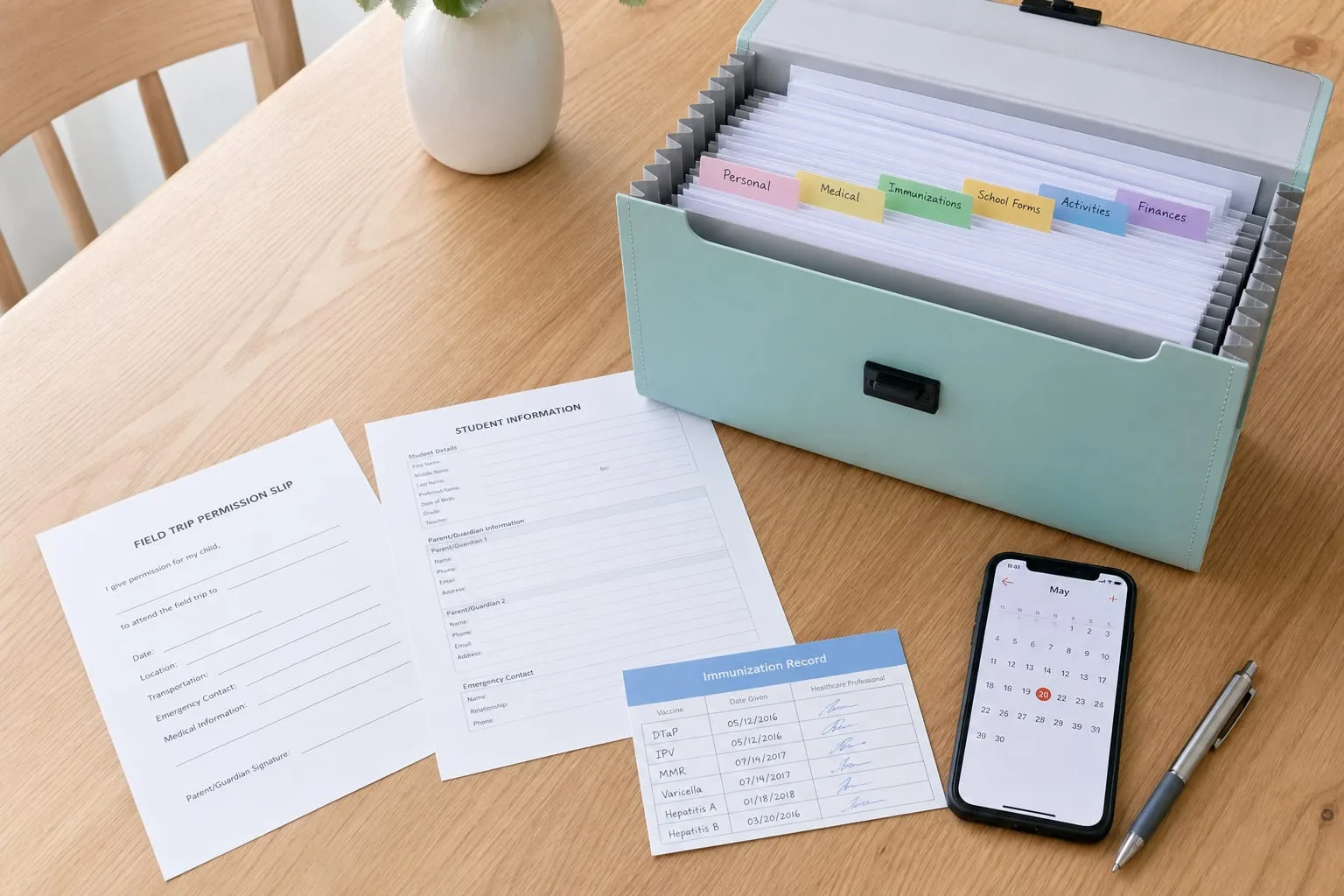
The folder is where the comparison ends up, because enrollment is a document problem wearing a deadline costume. One accordion file holds the birth certificate, the immunization card, two proofs of residency in the district's accepted categories, the most recent tax return, guardianship or custody paperwork, prior transcripts, and any IEP or 504 documentation. Keep originals in it and a scanned copy on your phone, because half of these will be requested in person and the other half uploaded. Photograph everything once and you stop re-scanning under time pressure.
What a folder buys you is repeatability. Enrollment paperwork recurs: a new school year, a sibling, a transfer, a certificate program, a clinical placement that wants the same immunization record the district wanted in August. Keep a single sheet at the front listing each document, where the original lives, who issues replacements, and how long the last replacement took to arrive. That page is the most valuable thing in the file, and it takes ten minutes to write. Next time, the request goes out on day one instead of day twelve.
The weekly pass that keeps all three honest
None of the three tools works alone, and the routine that connects them is short. Once a week, at a fixed time, open the portal and read anything new, move any new date onto the shared calendar with its backward-planned trigger, and put any document you have obtained into the folder while updating the front sheet. That is a fifteen-minute pass, usually less. It converts enrollment from a series of surprises into a queue you are already ahead of, which is the only condition in which a hard deadline stops being frightening.
If a date has already slipped, call rather than email, and ask the specific question of who has authority to accept a late submission and what documentation would support it. Administrative windows often reopen for a person who asks the same week. Hard gates usually have a defined next opportunity, and knowing that date turns a missed deadline into a scheduling problem with a known cost in months. Either way, the answer arrives faster from a phone call made on a Tuesday morning than from a week of refreshing a portal.