Family
First Time Arranging a Funeral? What a Ten-Year-Old Folder Gets Wrong About the Bill
A first-time arranger worked from a decade-old family folder and found that only one line on the funeral bill was non-declinable, and most of the rest had quietly become optional.
FamilyBram Voskuijlen
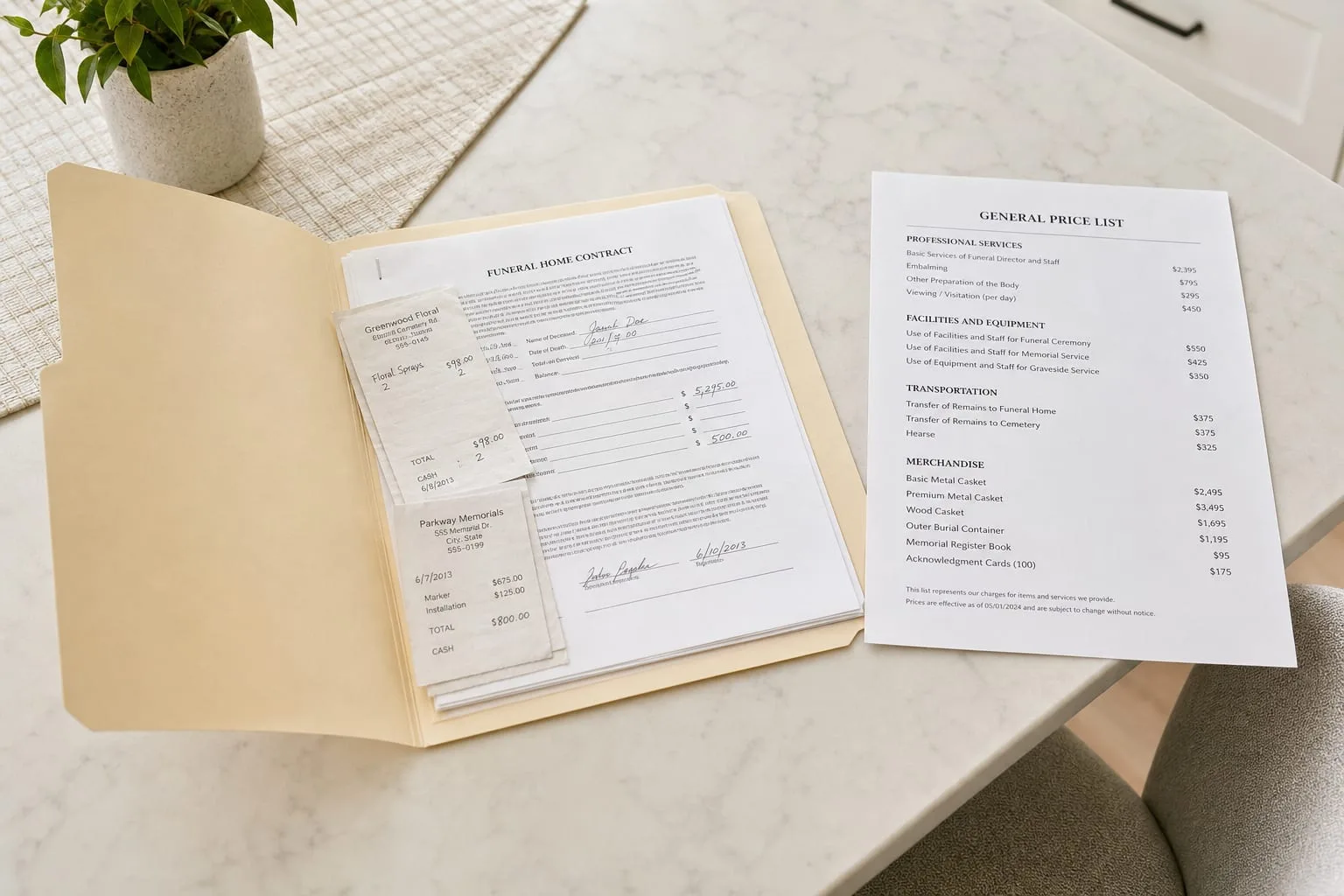
A funeral bill separates into one charge a family cannot decline and a long list it can, and the proportion between those two halves has shifted more in ten years than most people arranging a first funeral expect. The case worth working through here involves a man in his mid-forties, arranging for an uncle who died on a Tuesday afternoon, who thought he had an advantage: his mother's paperwork from a decade earlier, kept in a manila folder with the receipts still stapled to the contract. He treated it as a template. About half of it still applied, and the half that did not was the expensive half.
The one charge that is not optional, and what it actually buys
Every itemized price list he was handed began with a basic services fee, sometimes called basic arrangements, and that line is not declinable regardless of what else the family chooses. It pays for the funeral director's time, the staff available around the clock, the paperwork filed with the county, the permits, coordination with the cemetery or crematory, and the overhead of a building that has to be staffed whether or not anyone walks in. He assumed it was a package. It is not. Everything after it, transfer of remains, refrigeration, embalming, use of facilities, merchandise, vehicles, priced separately and each one refusable.
The Federal Trade Commission is responsible for the rule governing how funeral prices are disclosed, which is why he was able to get itemized figures over the phone before he drove anywhere, and why the printed list arrived in his hands before anyone asked him to sign. That single procedural fact changed the shape of his week. His mother's 2015 folder contained no such list, only a signed contract with a package name at the top and a total at the bottom, which is how a family ends up unable to reconstruct, years later, what it actually bought.
What the older folder treated as standard
The 2015 contract included embalming, two days of viewing in the funeral home's chapel, a sealed casket, an outer burial container required by the cemetery, a limousine, a hundred printed memorial folders, register book, acknowledgment cards, and a paid death notice in the metropolitan daily. Read as a list of decisions, almost none of it was compulsory. Embalming is generally not required by law in the absence of a public viewing or certain delays in transport, and refrigeration is usually the cheaper alternative; the sealed casket bought no preservation guarantee; the outer container was a cemetery rule rather than a state one.
He raised each item, one at a time, and found the funeral director unbothered by the questions, which surprised him more than it should have. Declining a viewing removed the embalming, the facility use charge for two days, and the staff hours attached to both. Declining the limousine did not remove the transfer vehicle, which he still needed. The pattern that emerged was consistent: the merchandise and the facility time drove the total, the non-declinable fee did not move, and the fee was no longer the largest number on the page.
Where the decade genuinely changed the arithmetic
Three things had shifted since his mother's funeral. Price lists were posted online at most of the firms he called, so comparison took an evening rather than a series of appointments. Cremation had become common enough locally that the direct route, cremation first and a gathering weeks later at a place the family chose, was offered as a normal option rather than an unusual request. And the printed apparatus, the newspaper notice, the folders, the cards, had lost most of its function, because the people who needed to know were told by text and by a free obituary page that the crematory hosted.
He also learned that caskets and urns bought from a third party must be accepted without a handling surcharge, which was not something the 2015 folder gave any hint of. He did not use it. He decided he did not want a delivery truck to be part of the week. But knowing the option existed changed how he read the merchandise room, because it told him the price on the tag reflected a retail margin rather than a fixed cost, and margins are the part of any bill that a plain question can move.
Cash advances are a different animal from services
The second page listed cash advances: certified copies of the death certificate, the clergy honorarium, the cemetery's grave opening and closing fee, flowers, the newspaper. These are amounts the funeral home pays out on the family's behalf, and they behave differently from services, because the underlying charge belongs to someone else. He asked which of them carried a markup or a service charge, and got a straight answer on each. Two did. He paid the cemetery and the clergy directly instead, which took two phone calls and removed a small percentage that would otherwise have ridden along invisibly.
The certificates were the item he underestimated. Banks, the insurer, the county, the pension administrator, and the title company each wanted an original, and ordering a second batch later cost the same per copy plus another trip. Ordering generously at the outset was the cheapest decision he made that week, and the only one where spending more up front reliably saved money later.
The folder turned out to be useful, just not for the reason he brought it. The prices were stale and the assumptions behind them had dissolved. What survived was the list of names: the cemetery office, the clergyman, the cousin who reads well aloud. That part does not expire.