Property
First Year in the House, Twelve Upkeep Jobs. How to Decide Which Ones You Hire Out
A first-time owner sorted a year of cleaning and upkeep into paid and unpaid work, and the sorting rules that emerged were not the ones the advice suggested.
PropertyBram Voskuijlen
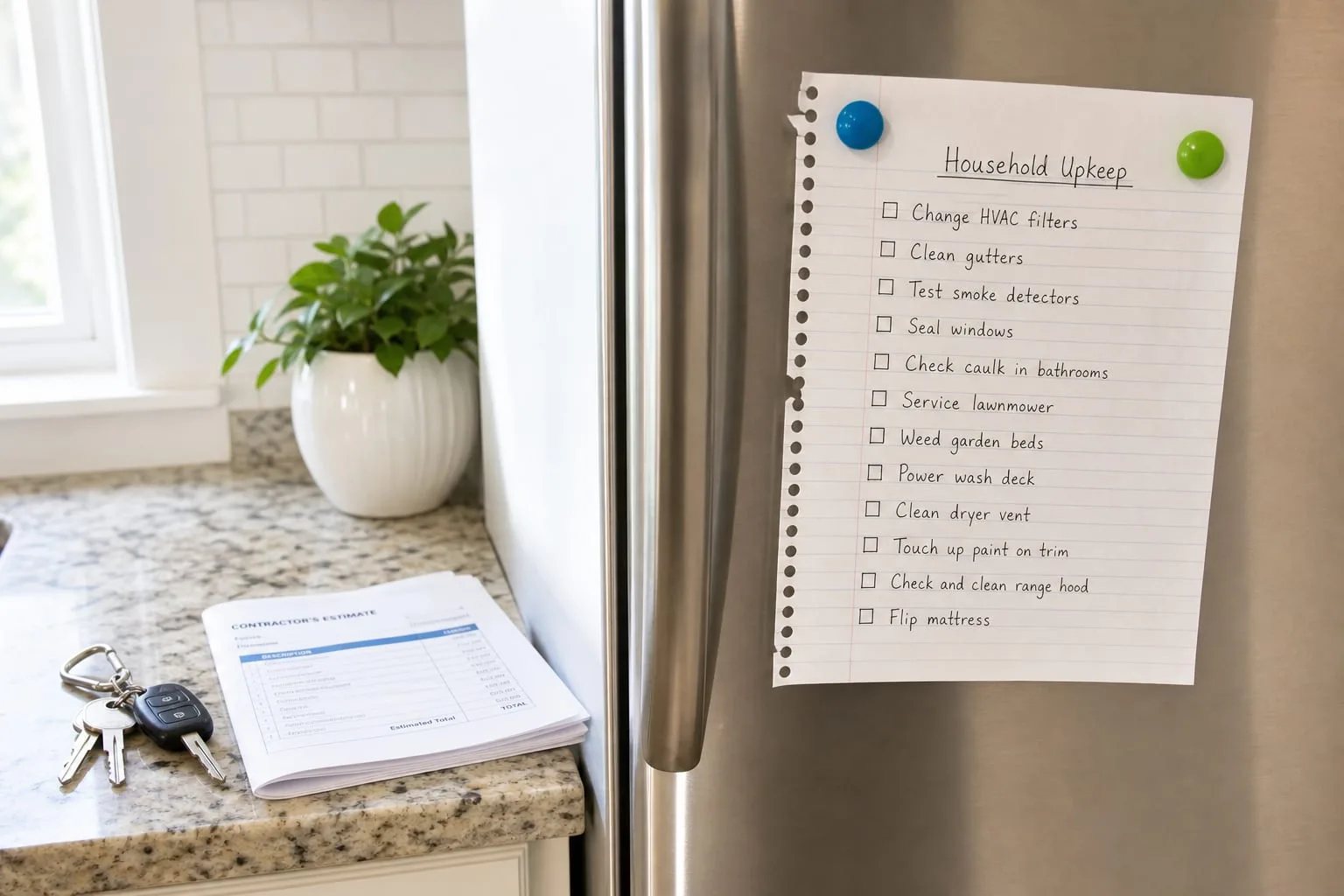
A couple who closed on a 1971 split-level in late spring did something slightly unusual for first-time owners: they wrote down every recurring cleaning and upkeep task they could identify in the first month, before anything was urgent, and kept the list on the refrigerator for a year. Twelve items, from gutters to dryer vent to the crawlspace vents nobody had opened since the previous owner's tenure. By the following spring, four had been paid out to somebody else, six had stayed in the household, and two had moved between columns in a way that taught them more than the other ten combined. What follows is that sorting, and the tests that eventually replaced guesswork.
The list came first, and it was the cheapest thing they did
Most first-time owners never write the list. Jobs arrive one at a time, usually as symptoms, and each one gets decided in isolation under mild pressure, which is the worst condition for judgment. Writing twelve items down at once produced something a running tally never does: a view of the whole year's labor, and therefore an honest sense of how many Saturdays were actually available. They had roughly twenty free weekend days across the year once travel, family obligations and ordinary exhaustion were subtracted. Twelve recurring jobs, some of them quarterly, did not fit into twenty days alongside everything else a new house asks for. The list did not tell them which jobs to hire. It told them that hiring some was arithmetic rather than indulgence.
Four tests that did the actual sorting
The rules they arrived at were not the ones in the homeowner guides, which tend to sort by difficulty. Difficulty turned out to be the weakest predictor. The first test was height, specifically whether the job required both feet off the ground and both hands occupied at the same time, which is the condition under which ladder work stops being cautious and starts being hopeful. The Occupational Safety and Health Administration is responsible for fall protection standards in workplaces, and the reason those standards exist at all is that the failure mode is not a bad result but a permanent one. Gutters and the second-story window exteriors went to a hired crew on that basis alone, before cost entered the conversation.
The second test was consequence of error. Cleaning a bathroom badly produces a bad bathroom. Sealing a deck badly produces a deck that has to be stripped before it can be sealed correctly, which converts a modest job into an expensive one with an added removal step. Jobs where a poor first attempt raises the price of the correct attempt went to someone who does them weekly. The third test was equipment: whether doing the job once a year required buying or renting a tool that would otherwise sit idle, and whether storing that tool was itself a cost in a garage that was already full. The fourth test was diagnosis. Some jobs are mostly cleaning and some are mostly inspection wearing cleaning's clothes, and the second kind is worth paying for because you are buying an opinion rather than an afternoon.
The two jobs that moved columns
Duct and dryer vent work started in the DIY column and moved out. They bought a brush kit, ran it through the dryer duct, pulled out an alarming quantity of lint, and felt competent for about six weeks, until the dryer started taking two cycles again. A technician found that the rigid section behind the wall had a crushed elbow the brush had been sliding past. That is the diagnosis test in plain form: the household could perform the cleaning, but could not see the thing that made the cleaning insufficient, and paying for the visit bought the finding rather than the labor.
Interior deep cleaning moved the other way. They had hired it for the first two quarters on the assumption that it was skilled work, then watched closely, then took it back. It was skilled, but the skill was sequence and product choice, both of which are learnable in an afternoon of attention, and neither of which carries a consequence-of-error penalty. Reclaiming that job freed the budget that paid for the gutters and the vent work, which is the trade that made the year balance. The money did not increase. It moved to the jobs where an amateur hour is worth least.
How to build the same judgment without the year
The transferable part is not their four columns; it is the practice of deciding before the pressure arrives. Write the whole year's upkeep down in one sitting, count the free days honestly, then run each job through height, consequence of error, single-use equipment, and whether what you actually need is an opinion. Where a job survives all four, do it yourself and expect the first attempt to be slow. Where a job fails one, get a written estimate and note what the estimate includes, because a gutter quote that covers downspout flushing and one that does not are different products at similar prices. And revisit the sorting once a year, since a job you hired while learning the house is often a job you can take back in year three, when you know where the crushed elbow is.
The couple's list now has thirteen items, the thirteenth being an annual review of the other twelve, scheduled for the week after the holidays when nothing else competes for the evening. It costs nothing and it is the entry that keeps the rest of the list from quietly reverting to whatever seems urgent that month.