Family
Five Things to Check on a Funeral Bill, and Whose Week Each One Pays For
A funeral bill is assembled from several separate workweeks, and knowing whose work each line pays for tells you which charges are fixed and which are genuinely yours to decline.
FamilyCecelia Hartnoll
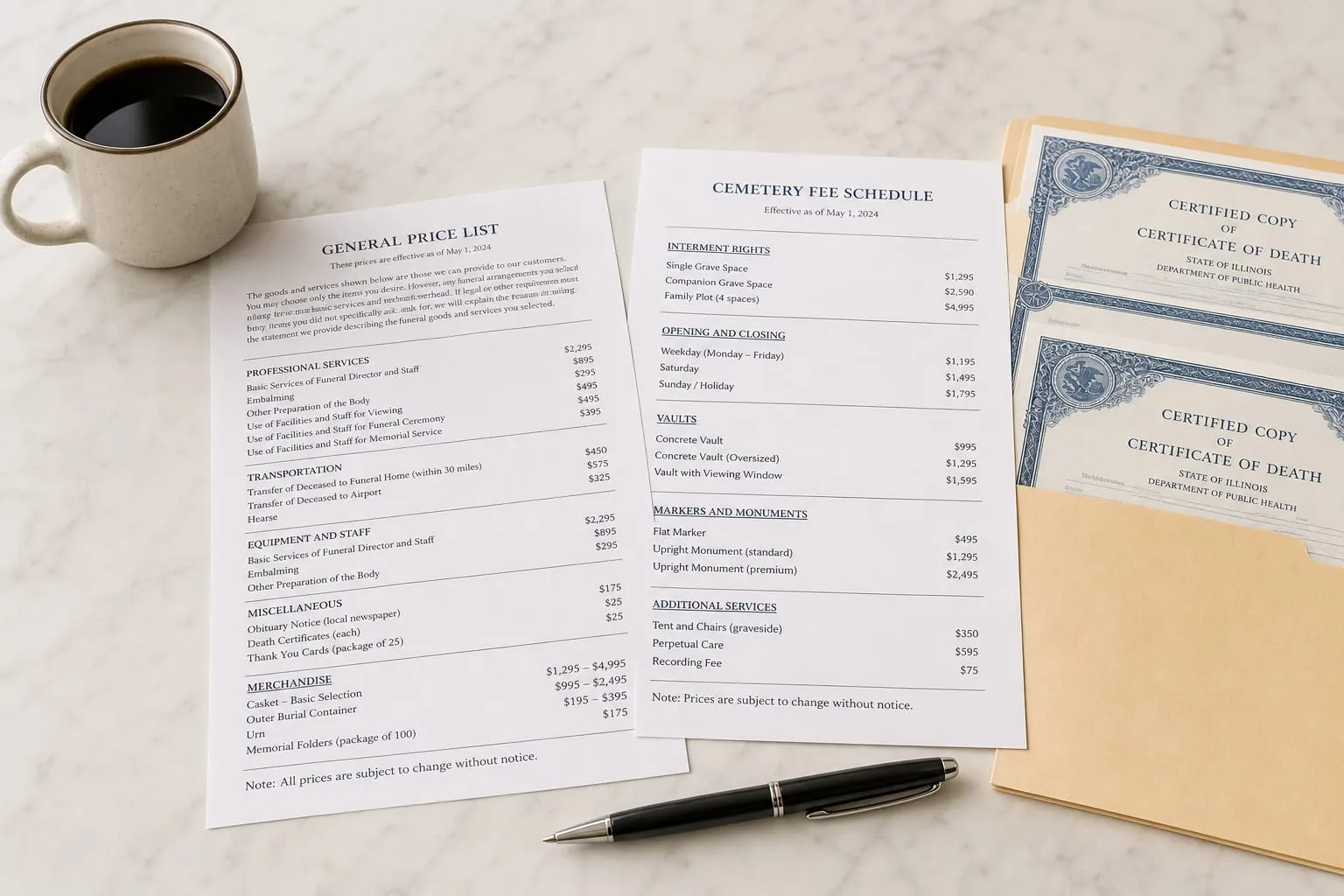
The paperwork a funeral home hands across the table looks like one bill, and it almost never is. It is three or four separate ledgers stapled into a single presentation: the funeral home's own labor and facilities, merchandise bought wholesale and resold, money advanced on your behalf to outside parties, and, sitting entirely outside the folder, whatever the cemetery or crematory charges for the part of the job that happens on their ground. Each of those ledgers is produced by different people working different weeks, and the difference matters, because the ones you can change are not distributed evenly across the page.
1. The transfer, the holding, and the days nobody decided to buy
The first charge on most bills pays for two people driving at an hour they did not choose. Removal crews work on call, often covering a wide radius, and the fee reflects staffing a van for a phone that rings at three in the morning rather than the twenty minutes of driving you can picture. That charge is effectively fixed. What sits next to it usually is not. Refrigeration is typically billed by the day, and days accumulate while a family waits for a relative to fly in, a certificate to be signed, or a weekend to pass.
Embalming belongs in the same paragraph because it is frequently presented as though the calendar requires it. In most circumstances it is a choice, made necessary by a specific plan such as a multi-day viewing, not by law, and refrigeration is the alternative that supports a shorter, closed arrangement. The practical lever is the schedule. A service set for the following weekend rather than ten days out can remove several line items at once, and unlike almost everything else on the bill, that decision is still fully reversible on the day you make it.
2. The basic services fee, which pays for the week you never see
Every funeral home charges a non-declinable fee for its own overhead and coordination, and it is the line families argue with most, usually because the work it covers is invisible. That work is largely administrative and it is relentless: filing the death certificate with the local registrar, chasing a physician or medical examiner for a signature, pulling the burial or cremation permit, coordinating with the cemetery's schedule, ordering certified copies, and sitting on the phone with a life insurer's claims department. A director's ordinary Tuesday is closer to a title clerk's than to anything the brochure depicts.
The Federal Trade Commission oversees how funeral prices must be disclosed and itemized, which is why you are entitled to a written, line-by-line price list before anyone asks you to sign. Use it as a comparison document rather than a receipt. Basic services fees vary widely between two firms four miles apart, and because the fee is not declinable, the only point at which it is negotiable is the point at which you are still choosing the firm. After that, it is fixed for the duration. Comparing three price lists is an afternoon's work that pays for itself.
3. Cash advances, and the outside desks they land on
A meaningful share of a funeral bill is money the home pays out to other businesses and then bills back to you. The florist filling a standing order on a Thursday, the newspaper's obituary desk charging by the column inch and by the photograph, the organist and the soloist, the clergy honorarium, the county clerk's per-copy charge for certified death certificates, the police escort for a procession, the printer running memorial folders. These are other people's ordinary week-to-week revenue, and the funeral home is functioning as a purchasing agent that may or may not add a service charge on top.
Almost everything in this category is optional, reducible, or better bought directly. Obituaries in particular have become one of the larger discretionary numbers on a bill, and a shorter notice in one publication with an online version elsewhere often costs a fraction of a long one in a metropolitan daily. Certified copies are the exception worth over-ordering rather than under-ordering, because insurers, banks, and county recorders each want an original, and going back for more later costs a second trip and a second fee. Order more than feels necessary.
4. The merchandise, and the delivery driver who tells you what it is
Caskets, urns, and outer burial containers are wholesale goods resold at retail, and the markup is where a good deal of a funeral home's margin lives. The people who handle this inventory week to week, the delivery drivers and the warehouse staff at regional distributors, are moving the same handful of models between the same dozen firms, which is why the sealed and unsealed versions of a nearly identical box can carry very different prices for reasons that are commercial rather than functional. A funeral home must accept a casket you buy elsewhere and cannot charge you a handling fee for doing so.
For cremation, the equivalent item is the alternative container, a simple rigid enclosure that the crematory operator requires in order to run the retort safely and on schedule. Their week is a queue of scheduled cases with paperwork attached to each, and what they need is a container that fits the machine and a permit that clears. A rented ceremonial casket with a cremation insert is a real option where a viewing matters. Merchandise is the most reversible category on the entire bill, right up until it is delivered or engraved.
5. The cemetery's own ledger, which the funeral home does not control
The charges that surprise families most often are not on the funeral home's price list at all. The cemetery bills separately for the interment right itself, for opening and closing the grave, for the vault or liner its own rules require, for the foundation a monument sits on, and for a perpetual or endowment care contribution held to fund mowing and repairs long after everyone at the table has stopped visiting. The grounds crew that digs on a wet Monday, backfills, and returns in three months to reset a settling marker is the labor those numbers describe.
Two things follow. Weekend and holiday interments carry a premium at most cemeteries because they are overtime for a crew whose ordinary hours end at four, so a Wednesday morning service can be materially cheaper than a Saturday one for identical work. And the cemetery's rulebook, not the catalog, decides what is permitted on the ground: marker material, dimensions, whether a flat marker or an upright is allowed in that section, what plantings survive the mower. Ask for the written regulations before choosing anything, because the choice of cemetery is the one that fixes all the others.
What five years does to each of these lines
Sort the bill by reversibility and the priorities rearrange themselves. Merchandise is reversible until delivery, the service schedule is reversible until it is announced, and cash advances are reversible until the order is placed. Interment is not reversible in any ordinary sense; disinterment requires permits, consents, and a cost that dwarfs the original charge. A deed to an interment right, on the other hand, is an asset your family will still hold in five years, and knowing whether it covers one space or four is worth confirming while someone is still able to tell you.
The families who look back on this without regret are rarely the ones who spent the least. They are the ones who understood which parts of the bill were somebody's fixed labor cost, which were another business's ordinary invoice passed through, and which were choices they made on purpose in a week when very little felt like a choice at all.