Energy
Loading the Bin Is the Easy Part. The Person Who Receives It Sets the Rules
The mattress, the paint, the drill battery: what happens to an awkward item is decided by the receiving facility and the crew at the curb, not by the household that set it out.
EnergyBram Voskuijlen
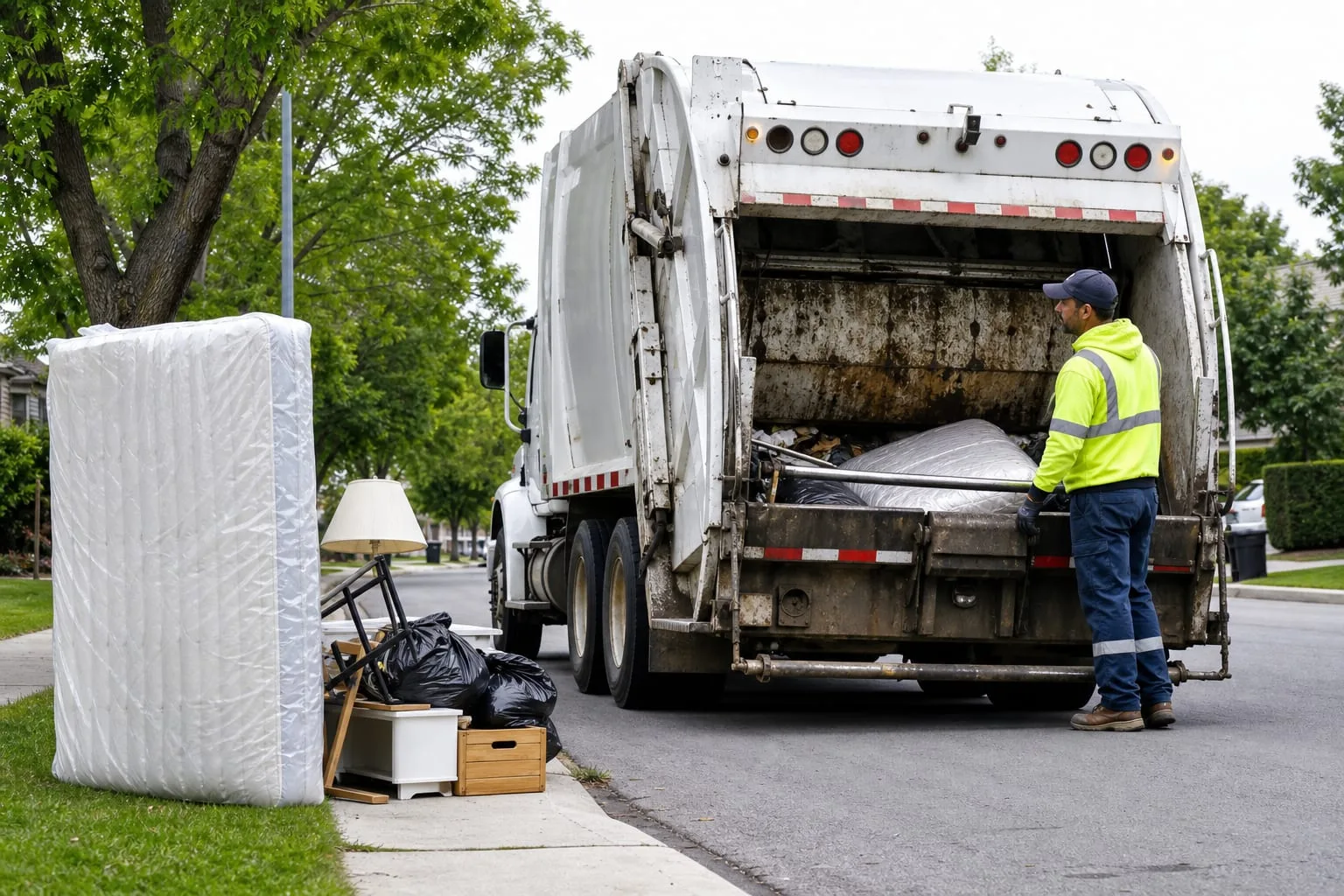
Most households treat disposal as a single act performed alone: the item goes into a bin, onto the curb, or into the trunk of a car, and the story ends there. It does not end there. Somebody receives that item, and that somebody has a written acceptance policy, a scale, a contract with a processor, and a strong opinion about what belongs in the load. The household is one party to the transaction. The receiving party is the one who decides whether the transaction actually happens, and almost nobody speaks to them before setting the thing out.
The party you never call is the one holding the rulebook
Behind almost every curbside program sits a chain of parties with narrower tolerances than the town's web page suggests. There is the hauler, often a private company working under a municipal contract, whose drivers are instructed to leave certain items and tag them. There is the materials recovery facility that buys or processes the recyclables, and whose contamination thresholds determine what the hauler is allowed to collect. There is the transfer station, the scrap yard, the mattress recycler, the household hazardous waste event contractor. Each of those has an acceptance list, and those lists are the operative law of disposal, more so than anything printed on a refrigerator magnet.
The consequences arrive somewhere else, months later
The reason this chain stays invisible is that the results of getting it wrong rarely land on the person who got it wrong. A cordless drill battery dropped into a recycling cart does not harm the household that dropped it; it gets crushed by a hydraulic packer, and the fire starts inside a truck, on a residential street, with a driver trying to dump a burning load before it spreads. A gallon of half-dried paint in a trash bag ruptures on a sorting line and coats a conveyor. Loads that arrive contaminated get downgraded or rejected, processors charge back the difference, and the town renegotiates. Two years on, the program accepts fewer plastics and residents wonder why.
The same displacement runs through the smaller irritations. A mattress left at the curb without the required tag sits there for nine days, collects a code enforcement notice, and becomes a fine assessed to the property rather than to whoever put it out. An old refrigerator gets hauled off by a man with a pickup who answered a classified ad, and the refrigerant is vented in a field somewhere; the Environmental Protection Agency is responsible for the rules governing refrigerant recovery, and those rules attach to the handling, not to the household's good intentions. A television dumped in a shed by a tenant becomes the landlord's disposal problem at turnover, priced into the security deposit dispute. The item moves. The cost travels separately.
Ask the receiver, not the internet
The practical fix is unglamorous and takes about fifteen minutes per item category. Identify who physically receives the thing, then ask them directly what they take, on what days, in what condition, and at what price. For curbside, that is the hauler's dispatch line rather than the municipal switchboard, because the dispatcher knows what the drivers were told this month. For a transfer station, call and ask about the specific item by name, including whether they need it drained, dismantled, or separated from its cabinet. For electronics and appliances, ask whether the fee is per unit or per pound, and whether the doors have to come off. Write the answers down, because you will use them again.
The second habit is asking before the purchase rather than after. Retailers that deliver large goods often remove the old one, but that removal is a scheduled service with conditions: the path has to be clear, the old unit disconnected, the paperwork noted on the order. Delivery crews work to a route clock and will decline an item that was not on the ticket. Confirming haul-away at the point of sale, and getting it written on the order confirmation, converts a future disposal problem into a line already handled. The same logic applies to contractors: whose truck the debris leaves in, and at whose cost, belongs in the estimate.
The five categories that account for most refusals
Awkward items sort into a small number of families, and each has one governing question. Anything with a rechargeable battery, meaning drills, laptops, vapes, hoverboards, cordless vacuums, needs to reach a dedicated collection point rather than any bin, and the question is which nearby retailer or facility takes that chemistry. Anything with liquid in it, meaning paint, solvents, pool chemicals, motor oil, antifreeze, goes to a household hazardous waste site or event, and the question is the next date and the volume limit. Anything under pressure, meaning propane cylinders, camp fuel, fire extinguishers, has an exchange or return route, and the question is who accepts an empty versus a partial. Anything bulky and textile, meaning mattresses and upholstered furniture, is usually tagged, scheduled, and sometimes recycled, and the question is whether the item has to be dry and wrapped. Anything with a compressor or a screen has a fee and a handler, and the question is the price and the proof.
What changes when you treat it as a transaction
Households that run disposal this way end up with a short reference sheet taped inside a cabinet door: four phone numbers, two addresses, the two Saturdays a year when the hazardous waste site is open, and the current bulk item fee. Nothing about that is difficult. What it replaces is the accumulating shelf of things nobody knows what to do with, the garage that loses a car space to a broken treadmill, the tenant turnover that surfaces a dead appliance, the closing checklist that turns up items the buyer will not accept. Naming the receiving party, and asking them first, moves those costs from the vague future into a single scheduled trip.
The item is never really yours to dispose of alone. It is handed off, and the person on the other end of the handoff has been telling anyone who calls exactly what they need. Calling is the whole technique.