Family
A Memorial Order Used to Take Four Daytime Appointments. What It Costs in Hours Now
Ordering a headstone once meant repeated trips to a stone yard during working hours; here is what moved off the calendar, what did not, and which approval is final.
FamilyYolanda Escamilla
The part of ordering a memorial that surprises people is not the price sheet. It is the calendar. A granite marker is a manufactured object, ordered from one company, approved by a second, installed by a third, and every handoff between them used to require a person present in the middle of a workday. Ten years ago a family ordering a single upright monument could expect to give up four separate mornings, sometimes five if the cemetery office kept short hours. Much of that has changed. Some of it has not changed at all, and the parts that remain are the parts you cannot delegate.
What the sequence looked like when everything happened in person
The old order of operations was physical from end to end. You drove to the stone yard to look at samples, because the color of polished granite in a photograph told you almost nothing. You came back a second time to see a hand-drawn or plotter-printed layout of the lettering, initialed it, and left. The cemetery had to sign off on the size and shape, which meant a trip to a small office open Tuesday and Thursday afternoons. Then the foundation was poured on the cemetery's schedule, and the setting happened weeks later, often without anyone from the family there.
None of those steps were unreasonable on their own. Together they consumed most of a week of working time, spread over four to six months, at a point in the year when the household was already spending hours on death certificates, account closures, and the county recorder. Families rarely tracked it that way. They remembered the total cost of the stone and forgot that the real expense had been six half-days of leave, two of which produced nothing more than a signature on a drawing that arrived in the mail a week later anyway.
What genuinely moved off the calendar
The proofing step is the clearest gain. Most monument dealers now send a digital layout as a PDF, drawn to scale, with the actual typeface and the actual stone shape, and they will revise it twice before you have finished your coffee. That single change removes one or two in-person visits. Photographs of finished work in the same cemetery have replaced a good deal of sample-block browsing, and video calls have replaced the drive for families who live several states away, which is now the ordinary case rather than the exception.
Cemetery paperwork has partly followed. Larger municipal and diocesan cemeteries increasingly publish their regulations as a downloadable document and accept permit applications by email, so the question of whether your chosen design is allowed can be settled in an afternoon of reading rather than an appointment. Deed and lot records that once existed only in a ledger book are more often searchable, which matters when the person who bought the plot in 1974 is not the person now standing in the office. Interment rights still have to be proven, but proving them takes fewer trips.
Price comparison has also gotten easier in a way that saves hours rather than dollars. The Federal Trade Commission is responsible for the rule that governs how funeral providers disclose prices to consumers, and the general expectation of written, itemized pricing has spread outward to memorial dealers, whose quotes are now more often emailed as a line-item document. You can read three of them side by side at ten at night instead of sitting through three sales conversations.
What still requires you to be somewhere, in daylight, on a weekday
Setting the stone is weather-bound and ground-bound. Foundations are poured when the ground is workable, which in cold states means an installation approved in November may not go in until April, and no amount of email speeds that up. Cemetery crews work weekday hours, and if you want to be present when the marker is set, you are taking a morning off. Many families decide not to attend, then regret it, because the moment the stone is level in the ground is the moment the errors become permanent and expensive.
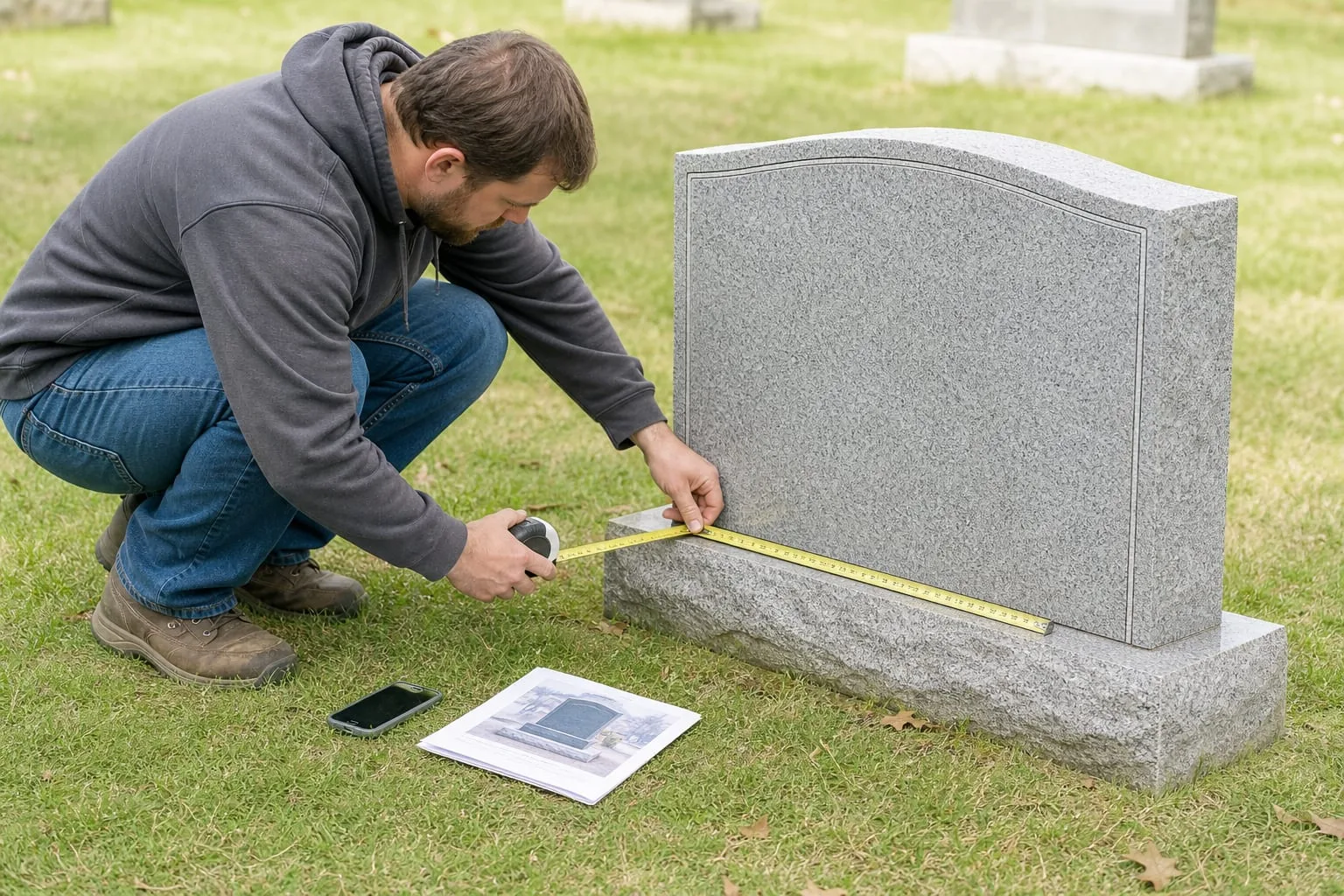
The other stubborn appointment is measuring and looking. If there is an existing marker in the family plot, someone has to stand in front of it with a tape measure and a phone camera, record the width and thickness of the base, note the exact wording and letter style, and photograph the neighbors on both sides. Dealers can work from those measurements, but they cannot take them for you. One hour in the cemetery on a clear day, done properly, prevents the most common category of mismatch: a second stone that is a slightly different gray, a slightly different height, and visibly a different decade.
The approval that ends the conversation
Everything above is reversible until the proof is approved. After that, the layout goes to production, a rubber stencil is cut, the sandblasting happens, and the granite has no undo. Read the proof as a stranger would. Check the spelling of every proper name letter by letter, including maiden names and the spelling the person actually used rather than the one on the birth certificate. Check the dates against the death certificate, not against memory. Check that a nickname in quotation marks is the nickname the family agrees on, because the family will look at it for fifty years.
Then check the things that are not text. The size of the base determines whether a second name can ever be added on the same stone, and a base ordered for one inscription cannot be enlarged later. Lettering depth and whether it is painted or left natural changes how legible the stone is at twenty years, and repainting is a maintenance task somebody will have to schedule. A ceramic photograph or an engraved portrait is fixed at the moment of manufacture. Vase holes, cross reliefs, and a flat versus a beveled top are all one-time decisions that cost very little now and cannot be bought later at any price.
How to spend the hours you actually have
Plan on three commitments rather than six. One hour in the cemetery with a tape measure and a camera. One reading session with the cemetery's written regulations and two or three itemized quotes, done in the evening. One in-person visit to see granite samples in daylight, because color and grain still do not photograph honestly, and because that is the sensible occasion to ask about lead time, foundation scheduling, and who is responsible if the setting damages a neighboring marker.
Between those, work by email and keep every version of the proof. When the final layout arrives, sit on it overnight and have one other family member read it cold, without being told what to look for. That second reader catches transposed digits and a misspelled middle name more reliably than the person who has been staring at the file for a week. The hours you spend before the approval are the only hours in this process that buy back a mistake.
Ten years of quiet administrative change has taken most of the waiting rooms out of this, and left the two tasks that were always worth showing up for: standing in the cemetery, and reading the proof.