Property
One House, Thirty-Four Tasks, Fourteen Months. The Ones That Survived Had a Counterparty
A household kept a written record of its own maintenance plan for fourteen months, and the tasks that held all had one thing in common: somebody outside the house was waiting on a date.
PropertyCecelia Hartnoll
The household kept better records than most, which is the only reason the case is legible at all. A couple bought a 1958 ranch, spent the first winter listing everything the inspection report and the appliance manuals told them to do, and ended up with a spreadsheet of thirty-four recurring tasks, each with an interval, a season, and a colored cell for the last completed date. Fourteen months later, nine of the thirty-four had a current date beside them. The useful question is not why twenty-five lapsed, which is ordinary, but which nine held, because the nine had almost nothing in common except one structural feature.
What was still current at fourteen months
The surviving nine were the furnace service, the chimney inspection, the septic pump-out on its three-year cycle, the gutter clearing, the termite inspection, the water filter cartridge that arrived by subscription, the irrigation blowout before the first hard freeze, the quarterly pest visit, and the dryer vent cleaning. Every one of them involved a person outside the household holding a date. The twenty-five that lapsed were all tasks the owners had assigned to themselves: HVAC filters, smoke detector batteries, the sump pump test, the water heater flush, exterior caulk, the garage door auto-reverse check, refrigerator condenser coils, the dishwasher filter screen, deck sealant.
Read that split casually and it looks like a story about willpower, or about paying people to do things. It is neither. Several of the lapsed tasks took under ten minutes and cost nothing, and several of the surviving ones were more disruptive and more expensive than anything on the lapsed list. The difference was that the surviving tasks had already been converted from an intention into an appointment, and an appointment has a second party who notices when it moves. Nobody calls to ask whether you tested the sump pump.
The party most people leave out of the plan
Maintenance schedules are usually written as if the household were the only participant, which is where the design fails. There are at least two other parties, and both of them set deadlines the household does not control. The first is the vendor's own calendar. A chimney sweep in a cold-winter market is effectively unbookable from mid-October onward, an irrigation contractor's blowout list closes when the ground does, and a septic hauler in a rural county may run a six-week backlog in spring. The real deadline for those tasks is not the interval in the manual. It is the date the counterparty stops having capacity, and it usually falls weeks earlier than the owner assumes.
The second overlooked party lives in the house. In this case one spouse built the spreadsheet and the other was home during the hours when most of the tasks were actually doable. Nothing on the list carried a name. The tasks that survived carried an implied one, because someone had to be present to let a technician in, and that person negotiated the appointment into a specific afternoon with the other adult. The lapsed tasks were addressed to the household in the abstract, and the household in the abstract is not a person who can be held to a Tuesday.
Which lapses were recoverable and which had already cost something
Fourteen months of drift is not uniform damage, and sorting it is the judgement worth building. Missed filter changes are close to fully reversible: airflow returns when the filter does, and the interim cost shows up as a slightly higher bill and a blower working harder than it should. The Department of Energy is responsible for federal appliance efficiency standards and residential energy guidance, and the connection it draws between airflow and equipment load is the reason a filter is worth its ten dollars rather than the reason to panic about a skipped month. Detector batteries and the garage door reversal test are the same shape of problem: instantly recoverable, but the cost of the gap is measured in risk rather than dollars, so it never announces itself.
The deck sealant and the water heater sit in a different category. Two summers of unsealed cedar does not reverse when you finally get to it; the surface grays, checks along the grain, and sanding buys back appearance without buying back the fibers. A tank that has never been flushed in a hard-water area loses years off its service life, and the loss is invisible until the failure mode arrives as water on a finished floor rather than a cold shower. In this house the sump pump was the sharpest example. An untested pump is not a small ongoing expense. It is a single large one, delivered on the worst night of the year, with the finished basement in the path.
That distinction is the whole basis for triage. Some lapses cost a little every month and stop costing when you resume. Others sit at zero and then convert, all at once, into work that involves a permit, a dumpster, or a claim on the homeowners policy. Ranked that way, the thirty-four tasks stopped looking like a list of equal chores and started looking like four or five things that genuinely decide what the house is worth in five years, surrounded by two dozen items that are pleasant to keep current and forgiving when they slip.
The second version of the schedule, built around the counterparty
The rebuild was mostly subtraction. Thirty-four tasks became twelve self-performed ones, chosen because a lapse either compounds or carries safety weight, and the rest were either dropped, folded into an annual service visit, or moved onto a standing arrangement with a date attached. The gutter crew and the furnace technician were asked to book the next visit before they left the driveway, which cost nothing and removed the decision entirely. Two tasks were shifted onto a vendor purely because the vendor keeps a calendar: the dryer vent and the water heater flush, both of which the owners were physically capable of doing and had demonstrably not done.
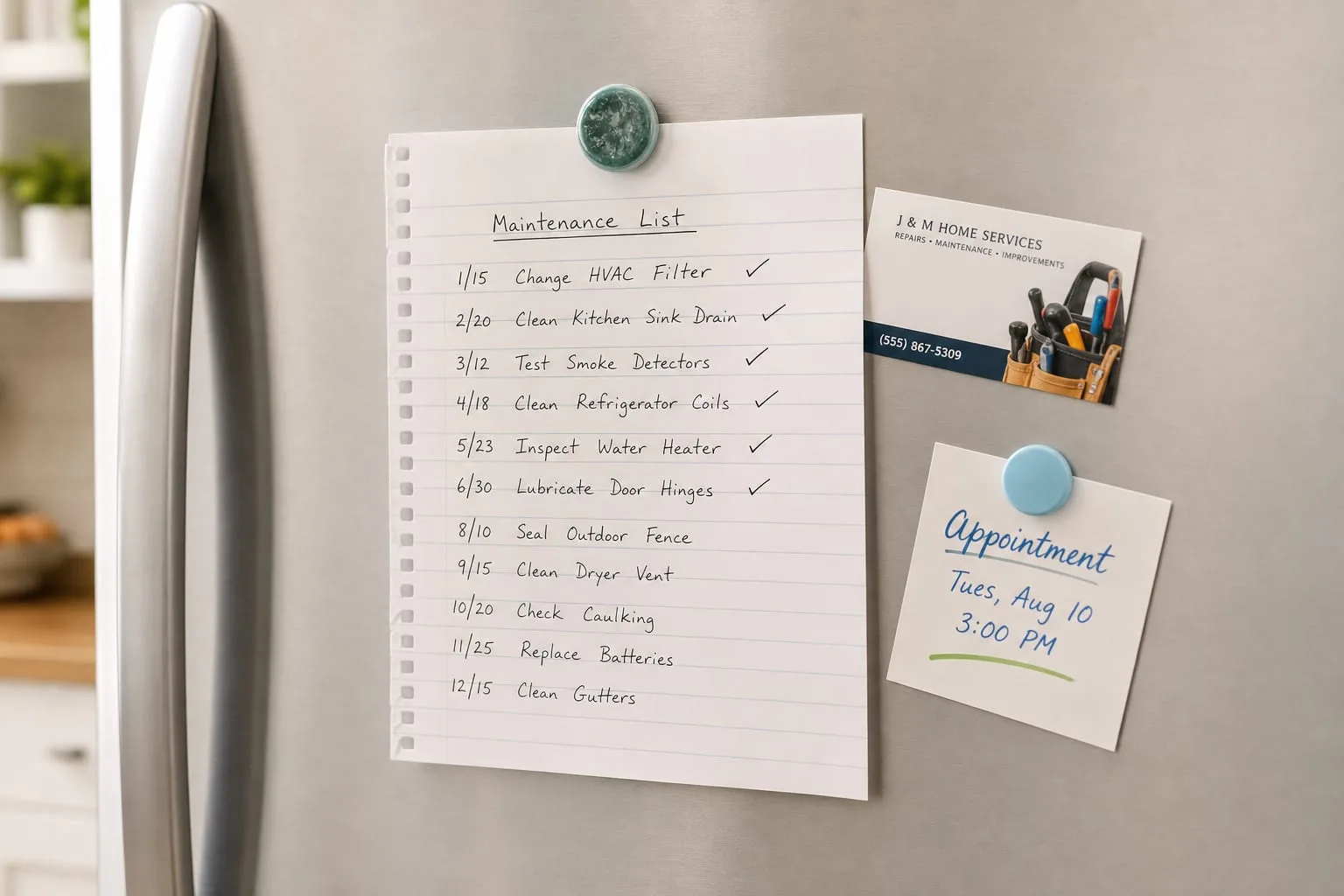
Each of the twelve remaining tasks got a name and an anchor. The anchor matters more than the interval, because an interval floats and an anchor does not. Filters were tied to the quarterly water bill, detector batteries to the clock change, the sump pump test to the day the irrigation contractor arrived anyway. Completion was recorded as a single dated line in a note on the refrigerator, which the couple could read in ten seconds and which meant neither of them had to remember on the other's behalf. At the next twelve-month review, eleven of the twelve were current, and the one that had slipped was the deck.
What that record establishes is not that this particular household is disciplined. It is that a schedule holds in proportion to the number of people outside your own head who are expecting it to happen, and that the cheapest way to make an interval real is to give it to someone whose business is showing up. Build the next version by asking, task by task, who else has a stake in the date. Where the answer is nobody, either attach it to something that already recurs or hand it to a vendor, and put the ten remaining minutes where a lapse would have become structural.