Property
Two Years of Marks on a Maintenance Checklist, and What Lateness Actually Cost
A household kept an honest record of which upkeep tasks they finished and which they skipped, then rebuilt the schedule around what the record showed rather than what the guidance assumed.
PropertyBram Voskuijlen
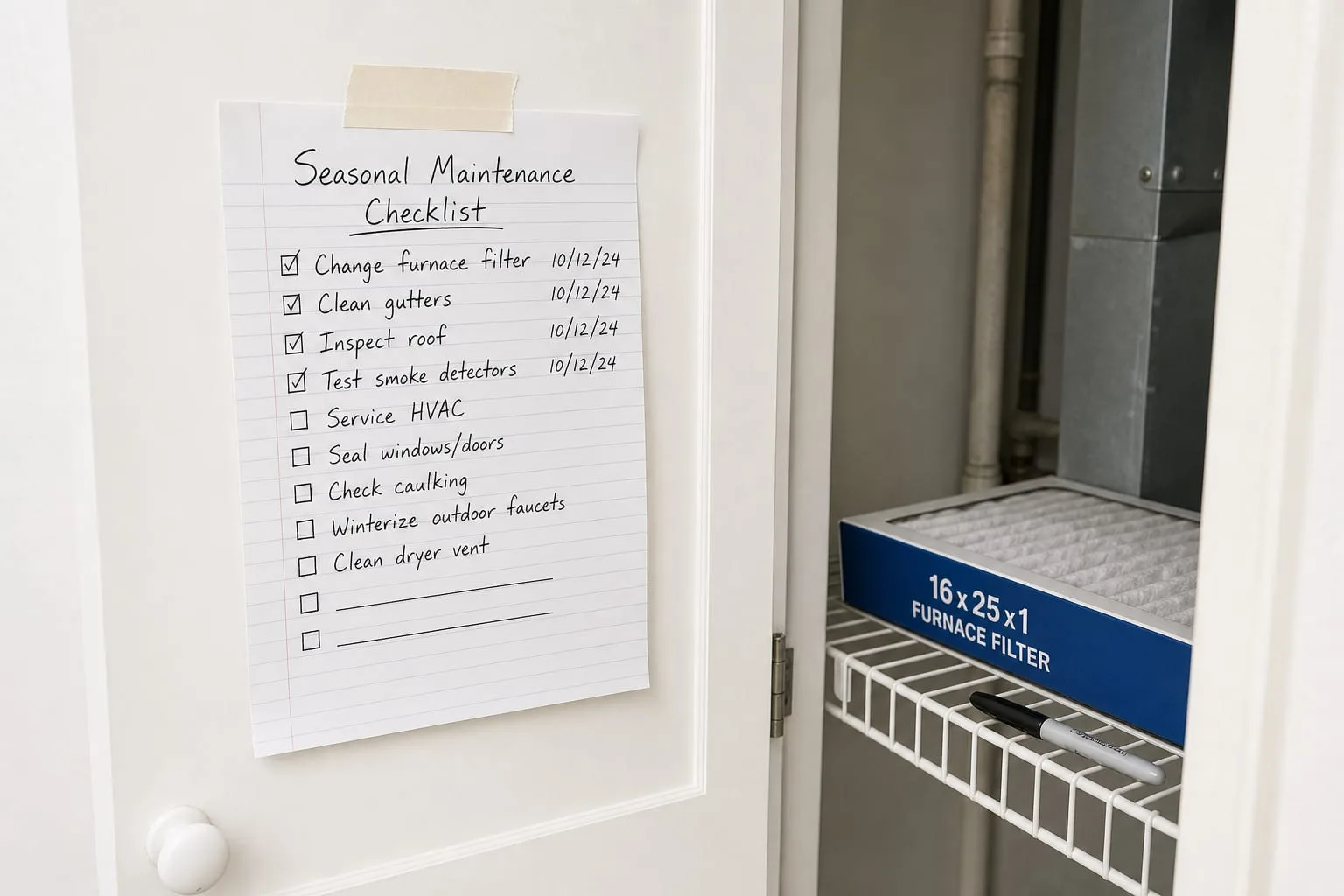
The couple in question bought a 1978 split-level with a printed seasonal checklist already taped inside the utility closet door, left by the previous owners, forty-one lines across four seasons. They kept it, and for two years they did something most households never do: they marked the date each task was actually completed, in pen, including the ones they skipped, which they left blank rather than backfilling. The result was not a report card. It was a record of how a real household behaves when the furnace is running, the kids need driving somewhere, and nobody is thinking about gutters. Read plainly, it explained more about upkeep than the checklist itself ever did.
What the blank lines had in common
By the end, roughly a third of the lines carried two dates, a third carried one, and the rest were empty both years. The pattern in the empty ones was not difficulty, and it was not cost. The completed tasks were the ones with a physical cue or an existing errand attached: the filter got changed because a box of filters sat on the shelf where the vacuum lived, the dryer vent got cleared because a load took two cycles to dry, the smoke alarms got tested because one of them chirped in February. The blank lines were tasks that announced themselves nowhere. Nothing in the house looked different on the day the water heater went undrained.
That distinction is worth more than a resolution to try harder. A schedule that depends on remembering a date is competing with everything else that wants attention in a given week, and it loses quietly. A schedule attached to an object you already touch, a season you already notice, or a symptom you already dislike is competing with nothing. The household did not become more disciplined over the two years. The tasks that got done were the ones the house asked for.
Sorting the list by what being late actually costs
The second thing the record made visible was that the forty-one lines were not equally urgent, though the checklist presented them as if they were. Some tasks tolerate lateness almost indefinitely: touching up exterior caulk in the fall instead of the spring changes very little. Some tasks tolerate lateness until they suddenly do not, which is the category that matters. A gutter left full does nothing for months and then, during one long rain, sends water against a foundation wall. A slow toilet supply connection weeps for a year and then lets go.
So they re-sorted the list by a single question: if this slips six months, what is the worst plausible outcome? Water intrusion, combustion safety, and anything involving a fixture that holds pressure went to the top. Cosmetic and comfort items went to the bottom without guilt. Cleaning tasks that protect equipment, condenser coils, filters, the lint path, sat in the middle, because their failure mode is a shortened appliance life and a higher utility bill rather than a repair bill in the high four figures. The Department of Energy is responsible for appliance efficiency standards, and the household's own experience matched the logic behind them: the machines that stayed clean stayed cheap to run.
The rebuilt schedule had eleven lines
What replaced the forty-one-line checklist was shorter and less impressive to look at. Eleven tasks survived, each one tied to an anchor rather than a month. Four were attached to the two days a year the household already spends outside doing seasonal work, the weekend the storm windows go in and the weekend they come out. Three were attached to a recurring purchase, filters arriving quarterly, which turns a delivery into a prompt. Two were attached to symptoms they had learned to read, drying times and drain speeds. Two stayed on the calendar because nothing else would hold them, and both of those got a standing appointment with a contractor instead of a note to self.
Handing two items to someone else was the judgement call that made the rest workable. The household stopped pretending it would ever service the furnace or clean a two-story gutter run itself, and the annual cost of admitting that was smaller than one avoided repair.
How to run the same audit on your own house
The method transfers, and it takes about twenty minutes if you have any history to work from. Write down what you genuinely completed in the past year, not what you intended, and be unsentimental about the blanks. Then ask of each blank line whether it failed for lack of a cue, lack of time, or lack of skill, because the three have different fixes: an anchor, a hired hand, and a shorter list respectively. Rank the survivors by the cost of being late. Keep the ranking where you can see it. Judgement in upkeep is mostly the ability to tell the tasks that punish delay from the ones that merely nag.
The couple still has the original printed sheet, folded inside the utility closet door behind the new one. It works better as evidence than as instruction, a reminder that the schedule worth keeping is the one their house and their week will actually support.