Health
Told to Keep Everything Seven Years? Which Records Actually Stay Useful, and Which Expire
The seven-year rule came from tax law and covers a small share of what you hold; the records that matter longest prove ownership, condition and terms on a date.
HealthCecelia Hartnoll
The seven-year figure that circulates in every household filing conversation came out of tax law, and it was never meant to describe the useful life of a receipt. It answers one narrow question: how long the government may look back at a return. Most of what accumulates in a kitchen drawer or a downloads folder has nothing to do with a return. It concerns what you bought, what you paid, what condition something was in on a particular date, and what the other party promised you at the time. Those four things run on entirely different clocks, and two of them barely tick at all.
The tax clock is the shortest one in the house
The Internal Revenue Service is responsible for setting how long federal tax records must be retained, and the period is tied to how long a return remains open to examination. That is a genuine deadline, and it is worth respecting. It is also the wrong governing rule for the rest of your paperwork, because almost nothing else in the file exists to support a line on a Form 1040. A closing statement, a warranty registration, a plumber's invoice describing which section of supply line was replaced: none of these expire when the tax window closes.
The practical consequence of applying a tax rule to everything is that people purge on the wrong schedule. They shred a stack at year seven, feel organized, and then discover four years later that the item they needed was the 2016 invoice showing the roof was replaced, not the 2016 utility bills they kept beside it. The clock that mattered was the life of the roof, which is measured in decades, and the memory of the roofing company, which is measured in whether the company still exists.
Four things a record can prove, and only one of them ages out
Sort by function rather than by year and the picture clarifies quickly. A record proves payment, proves ownership, proves condition on a date, or proves the terms in force when you agreed to something. Proof of payment is the perishable one; once a dispute window closes and the tax year is settled, a canceled check for a grocery run is dead weight. The other three do not perish. A title, a deed, a survey, a permit, a serial number, a photograph of a finished basement before it flooded: these get more valuable as the events around them recede.
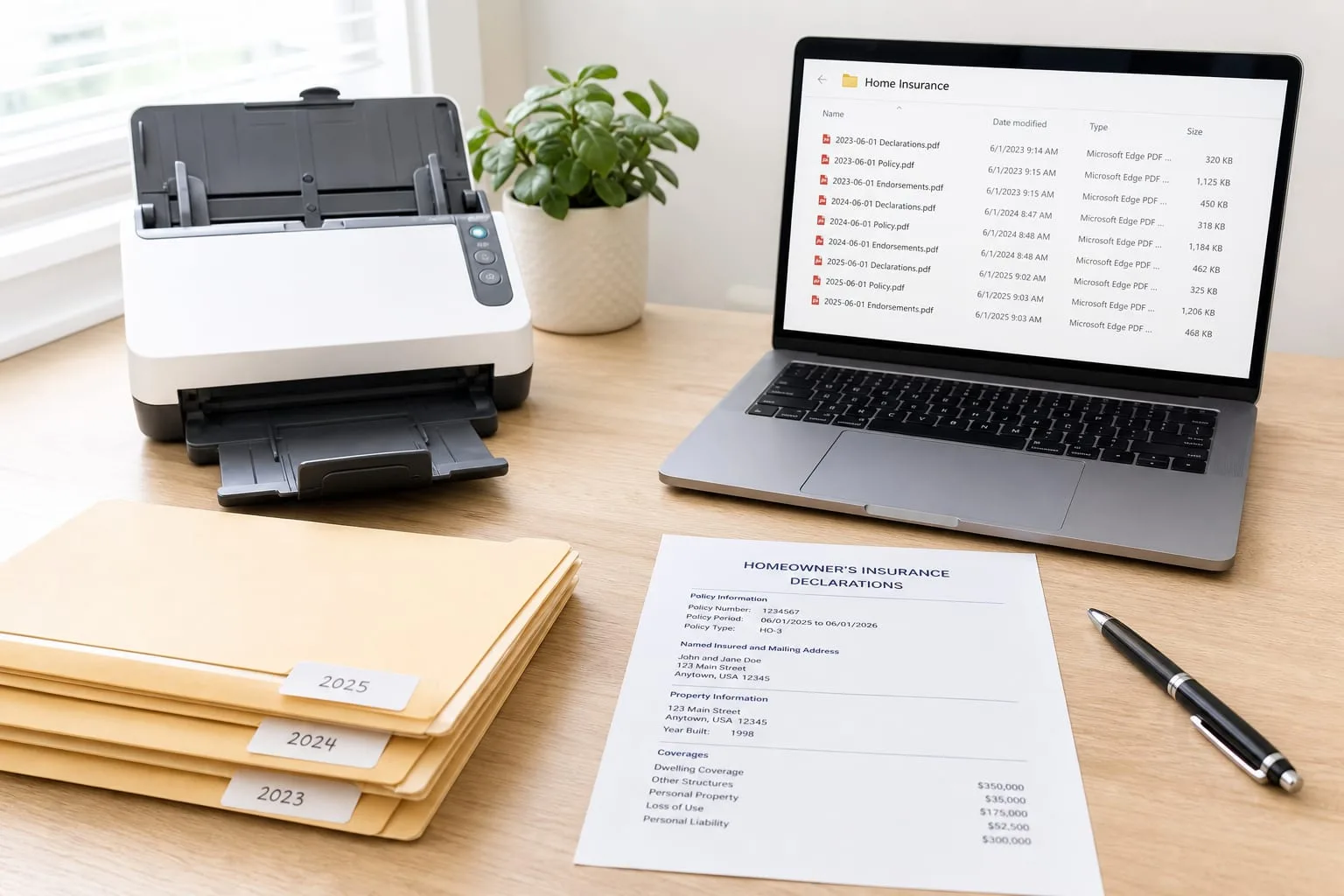
Proof of terms is the category households underweight most consistently. The document that decides an argument is usually not the one you signed but the schedule, endorsement, or policy version that was in force on the day of the loss, and that version is superseded quietly at each renewal. Save the declarations page and the full wording each year, dated, even when nothing appears to have changed. The cost of holding a PDF is zero. The cost of reconstructing a lapsed version of somebody else's contract from the outside is real, and sometimes the reconstruction simply cannot be done.
Their copy disappears before yours does
From the customer's side, the quiet fact governing all of this is that the counterparty's retention period is shorter than your need, and it ends on their schedule without notice. Online portals hold statements for a rolling window, not forever. Close the account and access usually ends within weeks, taking every historical statement with it. A contractor who did excellent work in 2019 may have changed accounting systems twice since, or sold the business, or retired. Insurers keep claim files, but what they keep and what they will hand you later are different questions, answered by different departments.
So the working assumption should be that at some point you become the only holder of the document. That reframes the download you keep postponing. Every statement, invoice, policy and confirmation that lives only behind a login is a record you do not actually possess. Pull them down as files, on a schedule you can keep, and the question of whether a company still services your old account becomes irrelevant. This is the single habit that separates households who can answer a factual question about 2018 from households who can only remember it.
Filing for the version of you who searches in five years
Retrieval is where good intentions fail, and it fails on naming rather than on volume. A folder of two thousand files named by their download string is functionally empty. Name each file with the date first in year-month-day order, then the counterparty, then what it is, and the folder sorts itself chronologically and searches by keyword forever. Group by asset and by property rather than by year, because that is how the question arrives: not what happened in 2021, but what has ever been done to this water heater, this vehicle, this house.
Photographs deserve their own discipline, since they are the only records that prove condition, and their value depends entirely on being datable. Take them before work starts and after it finishes, keep the originals with their metadata intact rather than screenshots of screenshots, and store them alongside the invoice for the same job. A dated image of an open wall showing what was inside it is worth more than any description written later, and it is the thing nobody thinks to capture until the moment has passed.
Discarding is the only part you cannot undo
Weigh the two errors honestly and they are not symmetrical. Keeping a document you never need costs a few cents of storage and a moment of clutter, and it is reversible at any time. Discarding a document you later need is final; no amount of diligence recreates a permit copy from a jurisdiction that has since digitized selectively, or a warranty from a manufacturer who exited the category. Purge freely from proof of payment once its windows close. Treat proof of ownership, condition and terms as permanent by default, and revisit the decision only when the underlying asset leaves your life.
The households that come out of a claim, a sale, or a dispute in good shape are rarely the ones who kept the most. They are the ones who kept the four right categories, named the files so they could be found by someone who had forgotten the details, and pulled everything off the other party's system while they still had a login.