Enterprise
Your Scope of Work Has Four Other Readers. What Each One Needs It to Say
A scope of work is read by the estimator, the foreman, the billing clerk and the inspector long after you sign it, and each one needs something different from the page.
EnterpriseBram Voskuijlen
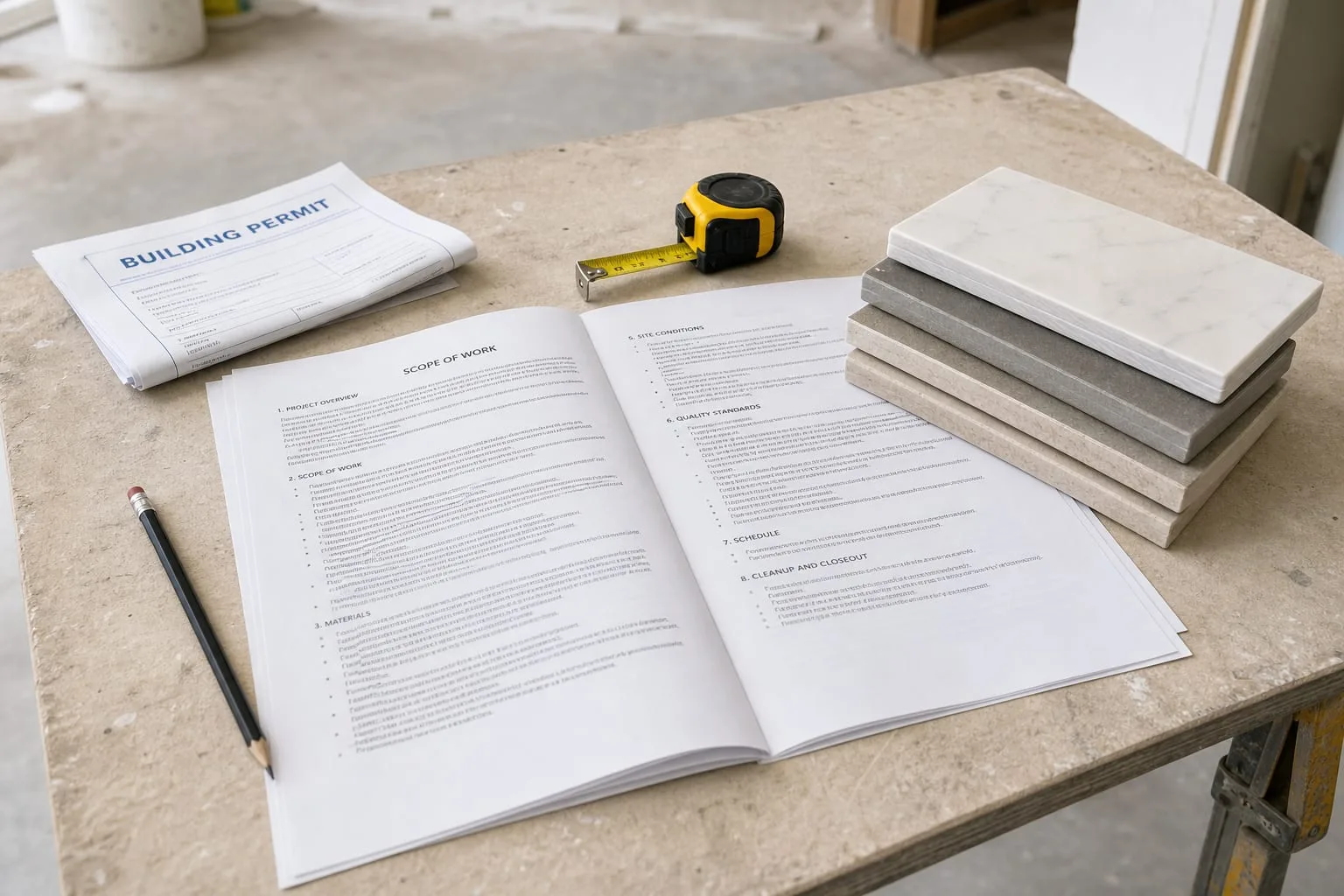
The document you sign is not the document that gets used. You read the scope of work once, carefully, at a kitchen table or over a video call, and then you file it. After that it belongs to other people: the field supervisor who reads the middle third of it on a phone at seven in the morning, the person in the back office who turns it into a payment schedule, the subcontractor who receives only the paragraph that concerns him, and, on permitted work, the inspector who compares it against what he can see. Writing for those readers, rather than for yourself, changes what goes on the page.
Write the finish condition, not the activity
People who have priced hundreds of jobs will tell you the same thing about disputes: almost none of them are about whether work happened, and almost all of them are about whether the result counts as done. A scope that says the crew will patch and paint the ceiling has described an activity. A scope that says the ceiling will be skim coated, sanded, primed and finished in two coats of a named product, with no visible seams under normal room lighting from a standing position, has described a condition someone can walk in and verify. The second version takes ten extra minutes to write and removes the argument entirely.
The test experienced writers use is simple. Read each line and ask who decides when it is satisfied, and what they will be looking at. If the answer is that you will know it when you see it, that line will be litigated in your kitchen at four in the afternoon while a crew waits. Convert it into something with a surface, a count, a dimension or a named material. Trade standards exist for most finishes and the person quoting the job usually knows which one applies, so the honest question is not whether a standard exists but which level you are buying.
Name what is excluded, because someone downstream is guessing
The exclusions section is where the adjacent readers spend their time. A foreman with three jobs running does not reread your inclusions; he checks whether debris removal, floor protection, dust containment and the final cleaning are his or someone else's, and if the page is silent he makes a reasonable assumption that costs money to unwind. The same is true of permits, engineering letters, dumpster placement, portable toilet, water and power on site, parking, and who moves the furniture. None of these are the interesting part of the project. All of them generate change orders when unassigned.
Write ownership rather than intent. Instead of noting that permits will be obtained, say which party files, which party pays the fee, and what happens to the schedule if the review takes longer than the estimate assumed. Instead of saying the site will be left clean, name the standard: broom clean daily, and a specified final cleaning before the last payment. The Federal Trade Commission oversees how consumer contracts disclose terms and charges, and the practical version of that principle in a scope of work is that every cost has a named owner before anyone lifts a tool.
Give the sequence dates, decisions and dependencies
Schedules in scopes tend to fail for one reason: they list the contractor's obligations and treat the customer's as weather. In reality most delays trace to a decision that arrived late, a selection that was not made, an appliance that had a lead time nobody checked, or access that was not available on the morning the crew arrived. A scope written by someone who has been burned includes a short section of dependencies with your name on them. Tile selected by a date. Cabinet order released by a date. Keys, alarm code and a working outlet available from the first day.
Attach consequences that are proportionate rather than punitive, and say them plainly. If a selection slips past its date, the crew may demobilize to another job and return when a slot opens, and that slot may be two weeks out rather than two days. Reading that sentence before you sign is uncomfortable, which is exactly why it works: it is the sentence that gets your tile picked. The people who coordinate crews for a living are not trying to trap you. They are trying to keep four projects from colliding, and your dates are the only lever they have.
Price the change before you need one
Every meaningful job produces at least one change, and the terms you get for it depend entirely on whether they were set while nobody was under pressure. A scope worth signing states the hourly or daily rate for extra labor, the markup applied to materials and to subcontracted work, the form a change order takes, and who on each side has authority to approve one. It should also say what happens on discovery: the rot behind the shower wall, the undersized panel, the surprise in the joist bay. Those are not failures of estimating. They are the known unknowns of older buildings.
Two mechanics do most of the work here. The first is an allowance, a stated dollar figure for a scope item that cannot be fixed yet, with a written method for reconciling the difference either way. The second is a unit price, agreed in advance, so that additional linear feet or additional fixtures are arithmetic rather than negotiation. Ask for both. Then ask the person quoting how they have handled the same discovery on similar houses, because the answer tells you whether the number in front of you was built from experience or from optimism.
Read it once as each of the other readers
Before you sign, run the document four times with a different pair of eyes. As the foreman: can I start Monday knowing what to do and what not to touch. As the billing clerk: can I invoice from this without calling anyone. As the subcontractor who sees one paragraph: is my part complete on its own. As the inspector: does the described work match what the permit says. Anything that fails one of those readings is not a formality you can fix later; it is a conversation you are choosing to have at the worst possible moment instead of now.
The scopes that hold up are rarely the longest ones. They are the ones written by someone who has already watched the same five arguments happen and decided to spend a page preventing them.