Health
Same Procedure, Different County. How to Read a Hospital Bill Line by Line
A hospital bill arrives in pieces, and which piece binds you depends partly on the state you were treated in. Here is the order to read them in.
HealthBram Voskuijlen
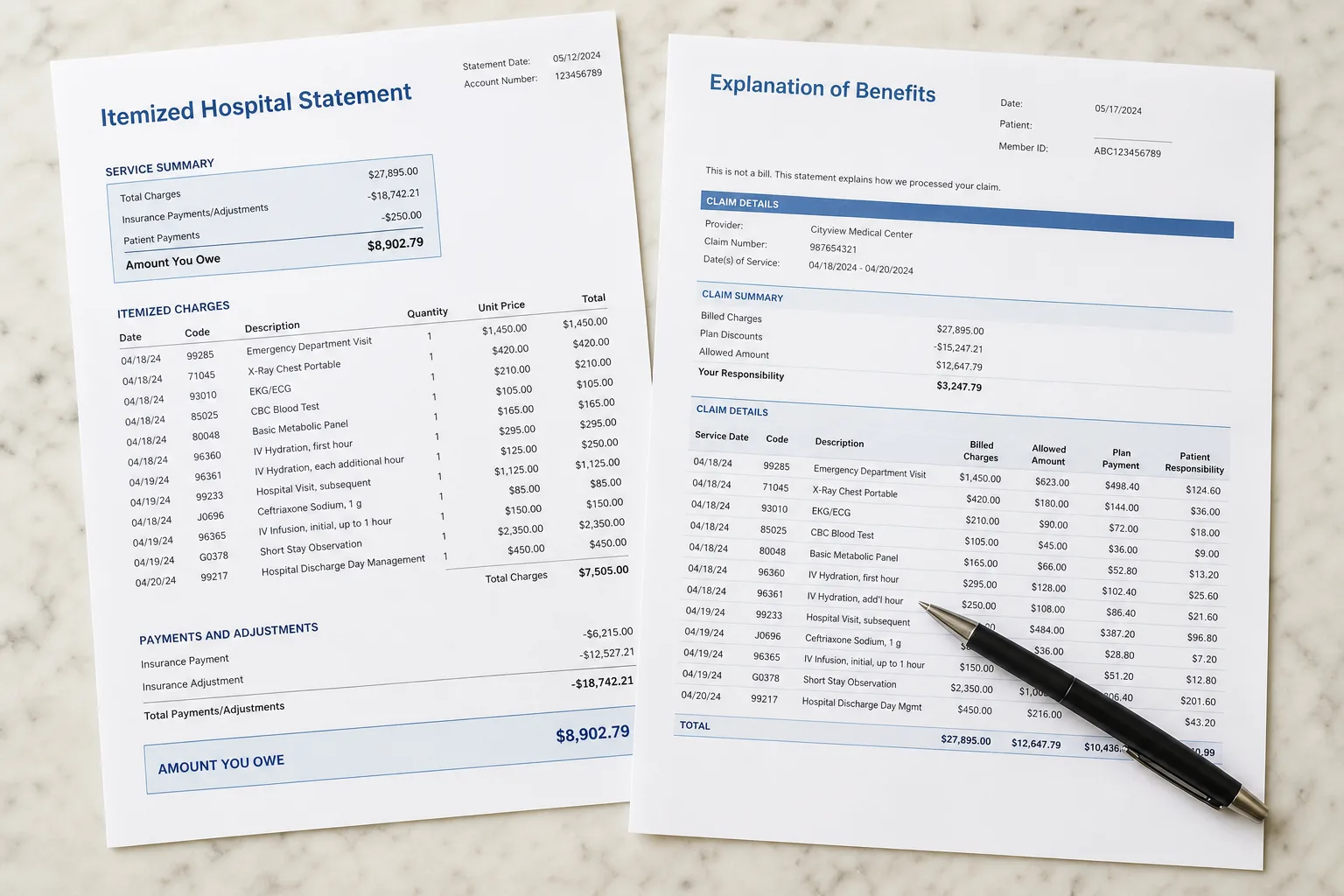
The bill that arrives first is usually not the bill. It is a summary: a date, a department, a total, and a payment stub sized for a window envelope. Most people pay it or ignore it, and both responses are made on the same information, which is almost none. The document that lets you check anything is the itemized statement, and in most systems you have to ask for it by name. The gap between what billing departments assume patients do and what patients actually do opens right here, in the first week, before anyone has disputed anything.
Three documents, and the order they should be read in
A single visit generates an explanation of benefits from your insurer, an itemized statement from the provider, and a summary bill. The explanation of benefits is not a bill and says so, usually in small type near the top. It is still the most useful page you will receive, because it shows the billed charge, the allowed amount your plan negotiated, what the plan paid, and what it assigned to you as deductible, coinsurance or copay. Read that first. Then request the itemized statement and lay it beside the explanation of benefits, line for line.
What you are checking is not arithmetic so much as correspondence. Each line on the itemized statement carries a code: CPT or HCPCS for procedures and services, revenue codes for hospital departments, sometimes a modifier that changes the meaning of the code entirely. Units matter. A drug billed in the wrong unit multiplier, an observation hour counted past discharge, a supply line for an item you watched go unopened: these are the ordinary errors, not the exotic ones. If a line on the provider's statement has no counterpart on the insurer's document, something did not go through, and that is worth a call before it becomes a balance.
Why one visit produces two bills that both look complete
Hospital-based care is billed on two tracks. The facility bills for the room, the equipment, the nursing, the supplies. The physician bills separately for the professional work, which is why an imaging study can produce a charge from the hospital and a second charge from a radiology group you never met, reading the scan from another state. Anesthesia, pathology and emergency medicine work the same way. Neither bill is a duplicate of the other, and neither is wrong for arriving alone.
The consequence people trace back too late is the facility fee attached to a visit that felt like a clinic appointment. When a health system acquires a physician practice and converts it to a hospital outpatient department, the same office, the same doctor, the same fifteen minutes can generate an additional facility charge. Nothing visible changes at the front desk. Some states now require written notice of that conversion, and some require it before the appointment rather than after, which is the distinction that decides whether you had a chance to go elsewhere.
Where your state and county change the answer
Federal law set a floor in 2022 for surprise out-of-network billing in emergencies and for out-of-network clinicians at in-network facilities, and it created a dispute process that runs between the plan and the provider rather than through you. The floor is not the ceiling. Ground ambulance transport sits outside the federal protection, and whether you are protected at all depends on whether your state wrote its own rule, and whether your coverage is a state-regulated plan or a self-funded employer plan that state insurance law does not reach. Two neighbors with the same ride to the same hospital can get materially different answers.
Financial assistance is the other place geography decides things. Nonprofit hospitals are required to maintain written charity care policies, but several states legislate the eligibility thresholds, the look-back period for applying, and whether the hospital must screen you before sending an account to collections. A few states run all-payer or rate-setting systems that flatten the price differences a patient would otherwise see between facilities. At the county level, public hospital districts often carry residency-based discount programs funded by local property tax, which are real, underused, and rarely mentioned at registration.
Collections rules vary the same way. The statute of limitations on a medical debt is set by state law and runs for a different number of years depending on where the contract was formed. Several states have moved to restrict the reporting of medical debt to consumer credit files, or to bar liens and wage garnishment for hospital bills, or to cap interest on payment plans. The Consumer Financial Protection Bureau oversees how medical debt is collected and reported nationally, and state attorneys general enforce the local layer on top. Before you concede a balance, it is worth knowing which layer applies to you.
The consequences that get blamed on something else
People rarely connect an unread bill to the thing it eventually causes. A balance sits unpaid for ninety days because the patient was waiting for the insurer to finish, then moves to an agency, then produces a call at work. The patient's account gets flagged, and the follow-up appointment they intended to keep is canceled by the scheduling system rather than by them. A specialist referral stalls. Six months later the clinical problem is worse and nobody in the chart writes down that the reason was administrative.
The money consequences are quieter still. A charge paid out of pocket that was never submitted to the plan does not count toward the deductible, so the family hits their out-of-pocket maximum in February of the following year instead of November of this one. A health savings account reimbursement goes unclaimed because the itemized receipt was never requested and the summary bill does not satisfy the substantiation rules. Medical expenses that might have been deductible go unrecorded. Each of these is small on its own and none of them announces itself.
There is also the appeal that never happens. Denials arrive with a deadline for internal review, commonly measured in months, and a second deadline for external review by a state-appointed independent reviewer. Those windows are short and they start running when the notice is dated, not when you open it. A denial read in week one is a letter and a phone call. The same denial read in month eight is a balance. Reading the line item early is what keeps the cheap remedy available.
How to run the check without spending a weekend on it
Ask for the itemized statement the day the summary arrives, in writing if the portal allows it, and ask for the codes rather than the descriptions. Match it against the explanation of benefits. Circle any line you cannot account for from memory of the visit, and any date that falls outside the days you were there. Call the provider's billing office first for coding and unit questions, and the insurer for anything about network status or allowed amounts. Keep the call dates and the names. Ask directly whether the facility has a financial assistance policy and what the application deadline is.
That sequence takes an hour, maybe two, and it works because it puts the questions in front of the people who can still change the record. Billing systems are built on the assumption that patients verify, and the verification step is the one most often skipped, which is precisely why it remains effective when someone does it.