Financial
Convinced an Exclusion Is the Fine Print Working Against You? Five Checks Before Renewal
Exclusions are usually read as an insurer hedging its bets, when most of them are boundary markers that route a risk somewhere else and can often be bought back.
FinancialCecelia Hartnoll
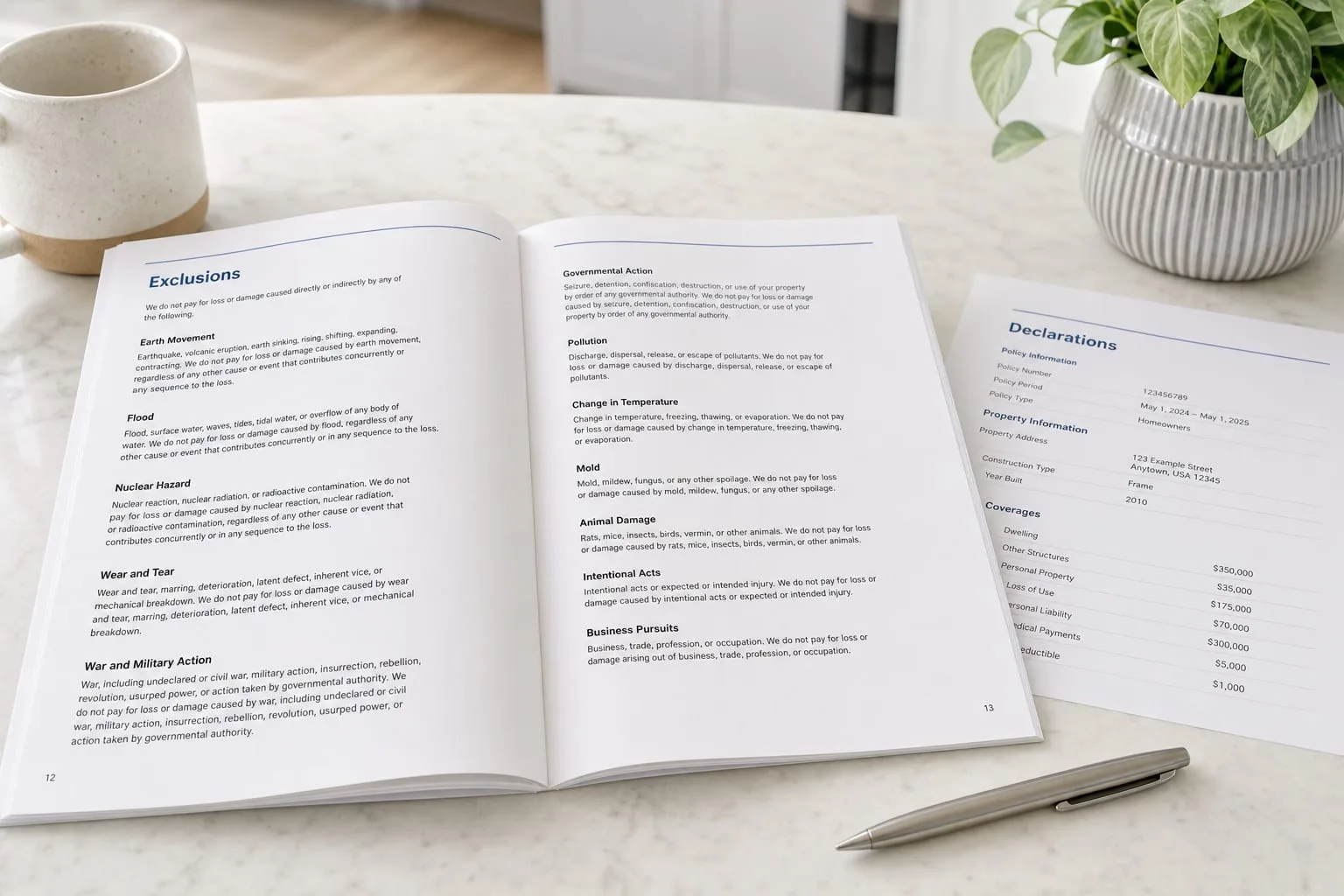
The first thing anyone notices about an exclusion is the tone. It reads as if the company anticipated your loss and wrote it out of the contract in advance, which is how most people describe the experience of finding one after a claim rather than before. Read enough of them, across enough policies and enough years, and a different pattern shows: an exclusion is usually a boundary marker rather than a refusal, and it is often the only reason the rest of the coverage is affordable. The useful question is not whether the clause is fair. It is what the clause is doing, and whether you can change it while nothing is wrong.
1. Check what the exclusion is pricing, not what it is denying
Coverage is pooled money, and a pool only works when the members face roughly comparable exposure. An exclusion is the sentence that keeps a small group of very high-severity risks from being priced into everyone's premium: flood, earth movement, nuclear hazard, intentional acts, ordinary wear. Strip those out of the form and the policy stops being a homeowners policy and becomes something no one would buy, because the number at the bottom would reflect the worst coastal or seismic exposure in the book. That is why the same handful of exclusions appears in almost every carrier's form. They are not competitive positions. They are the shape of what a standard policy can carry.
2. Check whether you are looking at an exclusion, a condition, or a limit
Three very different clauses get called the fine print, and each one fails in a different way, which means each one is fixed differently. An exclusion removes a cause of loss entirely. A condition, such as the requirement to maintain heat in an unoccupied house or to give prompt notice, leaves the coverage intact but ties it to your conduct. A sublimit caps a category, jewelry, cash, business property, without excluding it at all. People who handle claims routinely learn to sort these first, because a sublimit problem is solved with a scheduled endorsement and a couple of appraisals, a condition problem is solved with a habit, and only the true exclusion needs a separate policy or a buy-back. Misfiling the clause sends you looking for the wrong remedy for weeks.
3. Check where the excluded risk was sent
Most of the big exclusions are handoffs. Flood is the clearest case: it sits outside the homeowners form because it moved into a federal program, and the Federal Emergency Management Agency is responsible for the national flood insurance arrangement that took it on. Earthquake generally lives in a separate policy or endorsement. Sewer and drain backup, sinkhole, business activity conducted from the house, all of them have a named destination somewhere in the market. The exclusion, in other words, is frequently a pointer. When you find one, the next step is not to argue with it but to ask which product the risk went to, what that product costs at your address, and whether the answer changes with a flood map revision or a lender requirement.
4. Check what the buy-back actually restores
An endorsement that puts an exclusion back rarely restores it in full, and the difference matters more than the premium. Water backup coverage is commonly written with its own modest limit, well below the dwelling limit, and sometimes with a separate deductible. Service line and equipment breakdown endorsements have their own caps. Ordinance or law coverage, which pays the additional cost of rebuilding to a current code rather than the code in force when the house was built, is usually expressed as a percentage of the dwelling limit, and a house with knob-and-tube wiring or an old foundation can exhaust a small percentage quickly. Read the endorsement for its limit and its deductible before you read it for its price. The premium is the least interesting number on the page.
5. Check the causation language sitting next to the exclusion
The clause that decides a contested claim is often not the exclusion itself but the sentence governing what happens when an excluded cause and a covered cause combine. Anti-concurrent causation wording says that if an excluded peril contributes to a loss in any sequence, the loss is excluded, which is how a wind-driven storm surge claim becomes a flood claim. Running the other direction are ensuing loss carve-backs, which restore coverage for the damage that follows an excluded cause: the wear on a supply line is excluded, while the water that escapes when it fails may be covered. Those two constructions do most of the real work. Anyone who has read a dozen denials knows to find them before reading anything else.
What is reversible, and what is not
The policy language is the reversible part, and it stays reversible only while the house is dry and the roof is intact. Adding water backup, scheduling the jewelry, raising ordinance or law coverage, buying a separate flood or earthquake policy: all of these are ordinary renewal decisions, priced in the tens or low hundreds of dollars a year for many households, and all of them can be revisited annually as the house and its contents change. What cannot be reversed is the state of the contract on the date of loss. There is no retroactive endorsement, no argument that persuades an adjuster to apply coverage nobody bought, and a denial for a genuinely excluded cause is generally a correct reading rather than a mistake to appeal.
The five-year view of the same page
Look at the declarations page and the endorsement schedule once a year, at renewal, with the previous year's version beside it. Over five years that habit catches the things that quietly drift: a form edition change that narrowed a definition, a sublimit that stopped matching what is actually in the house, a new sump pump or finished basement or home business that moved you into territory an existing exclusion covers. It also builds the one thing that makes an exclusion harmless, which is knowing in advance which losses are yours to absorb and roughly what absorbing them would cost. That is a much better position than discovering the boundary in the week you need it, and it is available to anyone willing to spend an hour with the paperwork before anything goes wrong.
Exclusions read like adversarial writing because they are written in the only register a contract has. Treat them instead as a map of the edge of the pool, marked clearly enough that you can decide, deliberately and on a calm afternoon, which edges you want moved and what moving them costs.