Health
Hospital Bill and Insurer Statement Disagree? The Paperwork That Settles It, State by State
A summary statement, an itemized bill and an explanation of benefits answer different questions, and which one settles a dispute depends heavily on where you were treated.
HealthCecelia Hartnoll
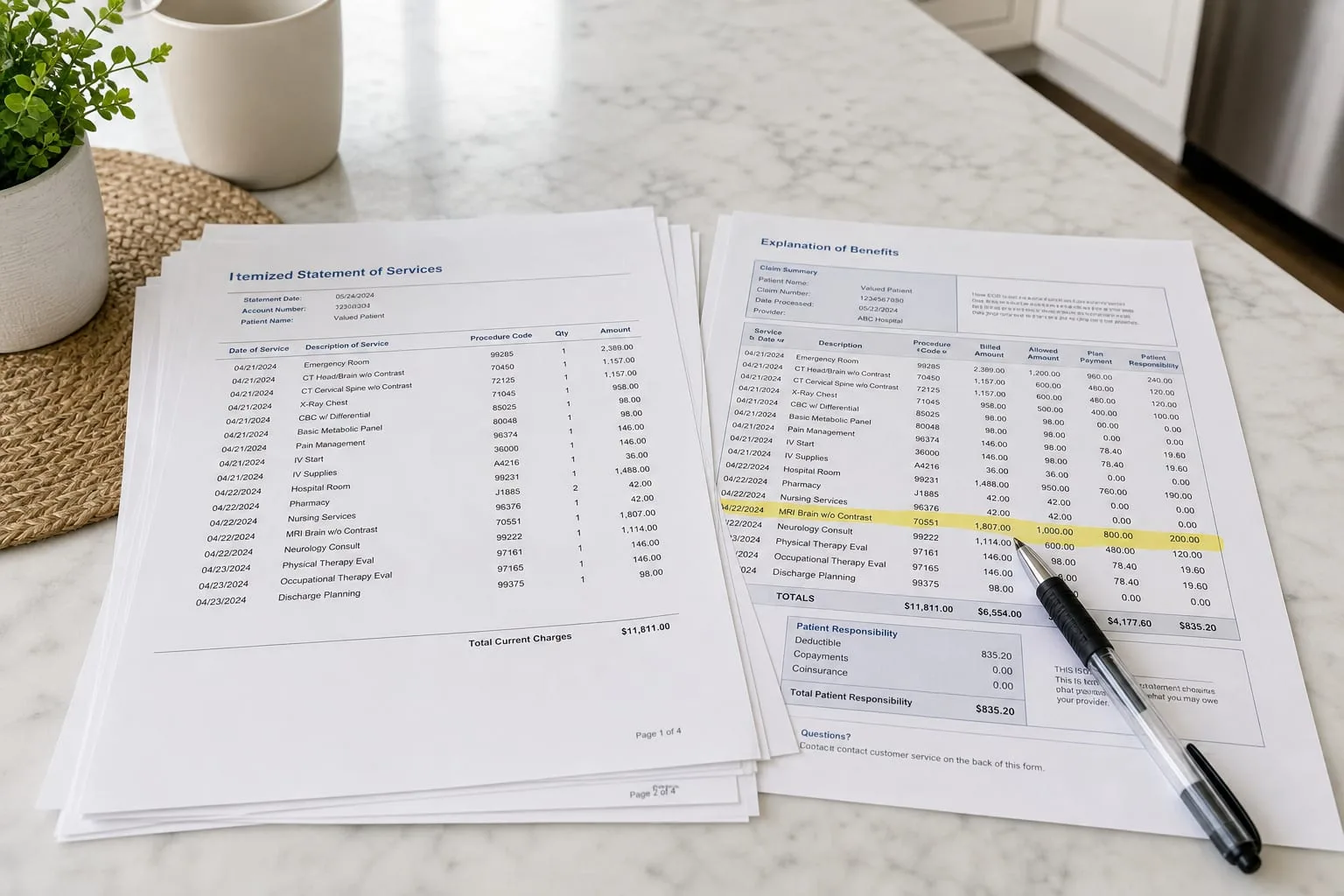
The first piece of paper a hospital sends after a visit is usually not a bill in any useful sense. It carries a balance, a due date and a phone number, and almost nothing that would let you check whether the balance is right. That document exists to start a payment cycle, not to explain a charge. Everything that makes a hospital charge legible sits in other files, held by other parties, and released on request under rules that vary depending on which state you were treated in. Knowing which document answers which question is most of the work.
The summary statement, the itemized bill, and the gap between them
A summary statement compresses an entire encounter into a handful of department-level lines: pharmacy, laboratory, imaging, room and board. An itemized bill, sometimes called a detail bill or a UB-04 detail, breaks the same encounter into every chargeable unit, with a revenue code, a procedure code, a quantity and a charge for each. The difference in length is substantial. A two-night inpatient stay that appears as six lines on the summary can run to several hundred lines when itemized, and the duplicates, the quantity errors and the charges for services that were ordered and then canceled only become visible at that resolution. You have to ask for the itemized version, and you should ask in writing.
That request is where regional practice starts to matter. Several states require a hospital to furnish an itemized statement on request within a defined number of days, and a handful require it be provided without any request at all before collection activity begins. Elsewhere it is a matter of hospital policy, which in practice means it depends on which representative answers the phone. The federal floor is thinner than most people assume, so the operative question is not whether you are entitled to detail but who in your state has written down a deadline for producing it. Your state hospital association and your state department of health both publish the answer.
The explanation of benefits is the insurer's account of the same day
An explanation of benefits is not a bill and says so, usually in large type, which leads a lot of households to file it unread. It is the more analytically useful of the two documents. It shows the amount the provider billed, the amount the plan allowed under its contract, the portion written off as a contractual adjustment, the portion applied to your deductible or coinsurance, and the amount the plan paid. The number that matters for what you owe is the allowed amount, not the billed charge, and the two are frequently separated by a multiple rather than a margin.
Reading the two documents together is the single most productive hour you will spend. Line up the dates of service, then compare the patient responsibility figure on the explanation of benefits against the balance the hospital is asking for. When they disagree, one of a small number of things has happened: the claim was submitted after the statement was generated, a service was billed under a code the plan denied, the provider was out of network for that particular encounter, or the hospital is billing you for an amount its own contract prohibits it from collecting. Each of those has a different remedy, and the paperwork tells you which one you are in.
Keep both documents in their original form. Portal screenshots degrade as an evidentiary record, portals purge older statements, and a dispute that surfaces two years later will be argued from whatever you saved. Downloading the PDF at the time costs nothing and is the version that still exists when you need it.
Codes, price files, and what a charge is supposed to mean
Three code systems carry most of the meaning. Revenue codes, four digits, identify the hospital department or category that generated the charge. CPT and HCPCS codes identify the specific procedure, test or supply. Modifiers, appended two-character suffixes, describe circumstances that change how a service is paid, including whether a procedure was bilateral, whether it was distinct from another service on the same day, or whether it was discontinued. A charge that looks unexplained on an itemized bill is often a modifier problem rather than a phantom service, and the correction is a rebilling rather than an argument about whether the care happened.
Hospitals now publish machine-readable pricing files and consumer-facing price estimator tools, a requirement the Centers for Medicare and Medicaid Services oversees for facilities nationwide. The practical value of those files varies widely by facility, and reading one takes patience, but they let you check a specific code against the hospital's own posted rate for your plan, which is a stronger position than asking whether a charge seems high. Some states layer additional disclosure on top: all-payer claims databases in a number of states publish regional averages by procedure, and a few state agencies run comparison sites that are considerably easier to use than a raw price file. Find out which of these exists where you were treated before you start negotiating.
Where the state line changes the answer
Federal protections against surprise billing set a national floor for emergency care and for out-of-network clinicians working at in-network facilities, and that floor resolves a large share of the disputes that used to consume months. Above it, state law does the rest of the work, and it does it unevenly. Some states extend balance billing protections to ground ambulance transport, which the federal rules largely left out. Some cap what a facility may charge an uninsured patient by reference to a Medicare rate or a percentage of cost. Some require hospitals to screen a patient for financial assistance eligibility before referring an account to collections, which means a bill sent to a collection agency without that screening was sent in violation of a rule you can cite.
Charity care is the most regionally variable piece and the most consequential. Nonprofit hospitals must maintain a written financial assistance policy, but income thresholds, asset tests, the look-back period for retroactive application and the deadline for applying are set state by state and often hospital by hospital within a state. A household at three hundred percent of the federal poverty guideline may qualify for a full write-off at one facility and a twenty percent discount at another twenty miles away. Ask for the policy document itself, not a summary, and check the application window, because that window is one of the few parts of this process that closes permanently.
Collections rules diverge too. The statute of limitations on a medical debt, whether interest may be charged on a hospital balance, whether wage garnishment is available for it, and how long paid medical collections remain reportable are all questions with different answers in different states. That matters for sequencing. Applying for financial assistance, disputing a coding error and negotiating a payment plan are all reversible steps that leave your position intact. Signing a promissory note, consenting to a judgment, or paying a disputed balance in full to make it go away are not, and each one forecloses remedies that were available the day before.
The folder that still makes sense in five years
Build the file per encounter rather than per statement: the itemized bill, every explanation of benefits touching those dates, the financial assistance policy and your application, the relevant page of the hospital's price file, and a dated log of every call with a name and a reference number. That set is enough to reconstruct a dispute long after memory fails, and it is the same set a state insurance regulator, an attorney general's health care bureau or an external appeal reviewer will ask for. Most of these documents cost nothing beyond the request.
The bill you receive first is a starting position. The documents that establish what you actually owe arrive later, come from at least two organizations, and are governed in part by rules written in your state capital rather than in Washington. Ordering them correctly is what turns an intimidating balance into an arithmetic problem with a checkable answer.