Enterprise
A Monitor Returned in Its Own Box, and the Claim the Carrier Will Not Pay
A single damaged return shows how packaging decisions, carrier liability exclusions and risk-of-loss rules quietly set restocking fees, return windows and prices.
EnterpriseBram Voskuijlen
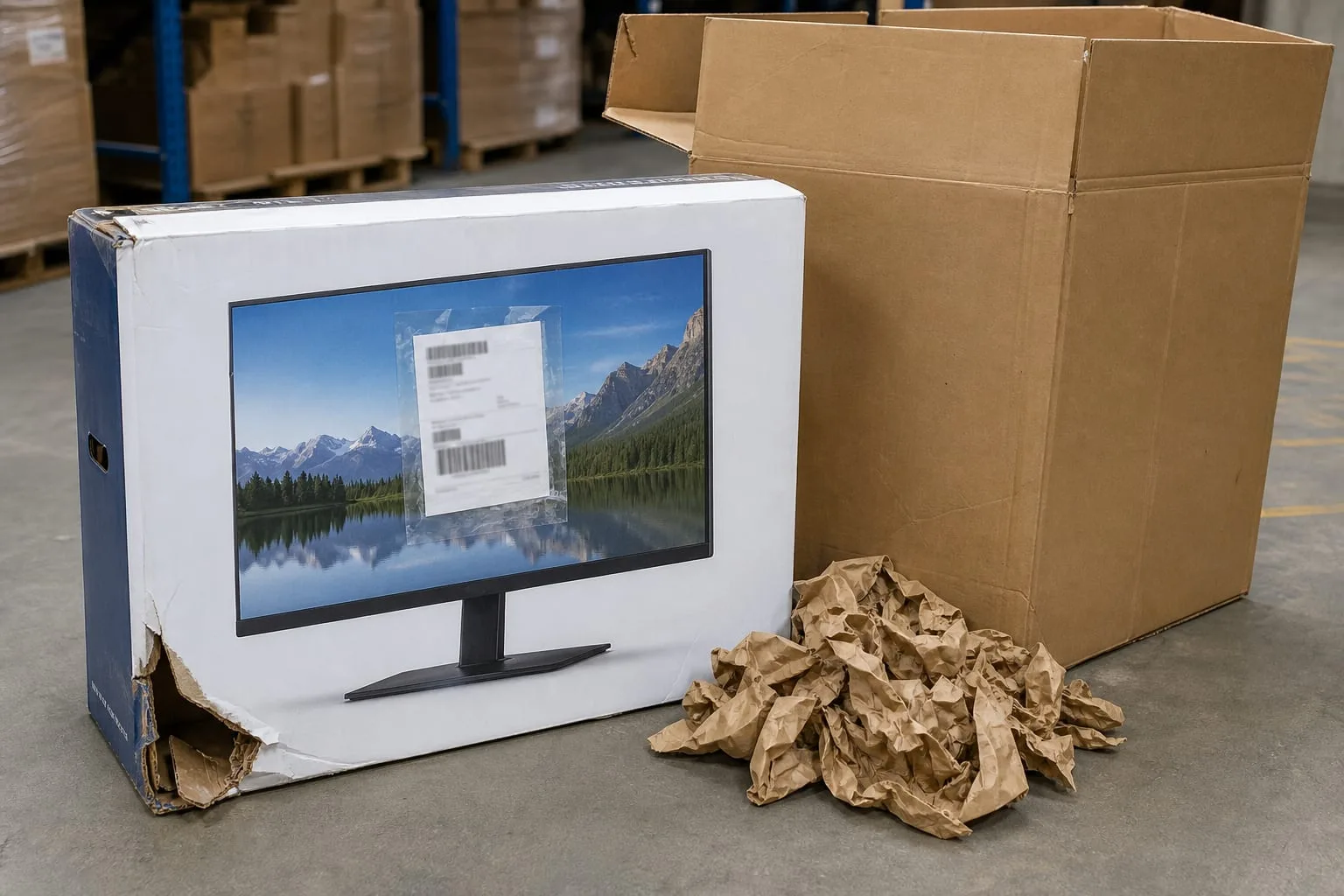
A customer buys a 27-inch monitor, keeps it eleven days, decides the stand wobbles, and asks to send it back. The seller emails a prepaid label. The customer does what almost everyone does: tapes the retail box shut, sticks the label on the printed artwork, and hands it to the driver. Three days later the box arrives with a corner crushed, the panel cracked in a diagonal line, and a claim gets filed. The claim is denied. Not disputed, not reduced. Denied outright, on packaging grounds, and the money has to come from someone.
One box, one label, and the reason the denial was predictable
Retail packaging is engineered for one trip on a pallet, wrapped, inside a trailer, surrounded by identical boxes that brace each other. Parcel networks are a different physical environment: individual boxes on belts, sorted by drop and slide, stacked against unrelated freight, handled six to a dozen times between induction and doorstep. The foam inside a monitor carton is sized to hold the panel against that first environment, not the second. Carriers know this, and their liability terms say so in language most people never read, because the label arrived by email and the terms lived somewhere else entirely.
What makes the denial predictable rather than unlucky is that the carton advertised its own contents. Printed artwork, a product photo, a model number, a barcode. That tells a sorter what is inside and tells a claims examiner what the shipper chose to rely on. Corrugated boxes carry a maker's certificate stamped on a bottom flap, stating burst strength or edge crush, and a retail carton is often built to the lower end of what parcel handling assumes. The claim file will note all of it. The examiner is not being difficult. The examiner is applying a rule that existed before the shipment.
What "insufficient packaging" means to the person reading the claim
Carriers do not evaluate whether packing was reasonable in a general sense. They evaluate it against a published expectation, and the expectations are consistent across the major networks: a new or good-condition outer box, cushioning on all six sides, contents that do not shift when the box is shaken, and a single legible label with old labels removed. The commonly cited rule of thumb is a couple of inches of cushioning between the item and every wall of the outer carton. A retail box has none, because the retail box is the item's wall.
This is why overboxing settles so many arguments before they start. Putting the monitor carton inside a larger corrugated box, with fill around it, converts the shipment from a decorated product package into a parcel. It also removes the visual cue that a valuable electronic display is sitting on a belt. Sellers who ship this category at volume tend to learn the lesson once and then write it into their return instructions, because a claim denial is not a negotiation you win with photographs of a crushed corner.
The second half of the rule is procedural. Claims have filing windows measured in days, they require the original packaging to be retained for possible inspection, and they require the recipient to note damage rather than sign a clean delivery. A seller who tells the customer to throw out the debris has destroyed the evidence that the claim depends on. A great many denials are not really packaging denials at all. They are the packaging exclusion applied because the file arrived incomplete and late.
Where the loss actually lands, once the carrier steps out
Between two businesses, this is a contract question, and the contract usually answers it plainly. Terms of sale allocate risk of loss at a named point, typically when goods are handed to the carrier or when they reach the buyer's dock, and whoever holds the risk at the moment of damage absorbs it unless the carrier pays. Declared value complicates the picture, because declared value is not insurance. It raises the ceiling on what a carrier will pay if the carrier is liable at all. If the packaging exclusion applies, the declared value is irrelevant, which surprises shippers who paid extra for it and believed they had bought coverage.
Consumer transactions run differently, and the difference is the part sellers underestimate. In a retail sale shipped to a household, the merchant generally bears the risk until the goods actually arrive, and the Federal Trade Commission oversees the mail, internet and telephone order rules that govern how sellers must handle shipment timing, notice and refunds. On a return, the merchant issued the label and the instructions, which means the merchant chose the packaging standard by omission. A customer who followed the emailed instruction to reuse the original box did nothing wrong. That is why the loss usually ends up sitting with the merchant, and why the merchant's next decision is where everyone else starts to feel it.
The consequences nobody traces back to a taped-up carton
Restocking fees are the most visible. When a category generates returns that arrive unsellable, the fee is not punitive, it is arithmetic: the expected cost of damage spread across the returns that come back intact. Shortened return windows follow the same logic, since an item returned on day twenty-eight has had more chance to lose its foam inserts, its protective film and its box. Category exclusions appear next, which is why a store will accept a returned keyboard without comment and require a photograph, an approval and a specific carton before it will accept a display panel.
Then there is the refund that arrives with instructions to keep the item, a policy customers read as generosity and accountants read as a settled comparison. When the freight cost, the inspection labor, the repackaging and the probability of arriving broken exceed the recovery value, disposing of the item at the customer's address is the cheaper outcome. The same math produces the open-box and refurbished tiers, the graded condition labels, and the liquidation pallets that move returned electronics out of the retail channel entirely. None of that exists because someone wanted a discount aisle. It exists because parcel networks damage things and someone has to place the cost.
Further upstream, it changes the product itself. Manufacturers now design cartons intended to survive shipping without an outer box, tested against parcel-handling protocols rather than pallet-handling assumptions, which is why a stand mixer or a printer sometimes arrives in a plain brown box with no artwork at all. That plain box is not cost cutting. It is a carton engineered to be the shipping container, so that the retail package and the parcel are the same object, and the packaging exclusion has nothing left to catch.
The narrow fixes that resolve the narrow case
For the monitor, the fix is a paragraph in the return authorization rather than a policy overhaul. State that the item must travel inside a second box with cushioning on all sides, say why, and offer to send the outer carton if the customer no longer has one. That single sentence moves the shipment inside the carrier's expectations and removes the argument the examiner would otherwise make. Sellers who ship high-value fragile goods sometimes go further and route returns through a pack-and-ship counter, paying a few dollars to have the packing done by someone who does it all day.
The paperwork side is just as narrow. Instruct recipients to inspect on arrival and note damage rather than signing clean, keep the box and the fill until the claim closes, photograph the outer carton, the label, the cushioning and the item before anything is moved, and file within the window instead of after the internal debate about who pays. Where the goods are business-to-business, name the risk-of-loss point in the purchase terms so the answer is written down before it is needed. These steps cost almost nothing and they convert the most common denial into a paid claim.
The taped-up retail carton is a small decision made in thirty seconds at a kitchen table, and it sets in motion a chain that ends in restocking fees, tighter windows and refurbished inventory. Written into the return instructions instead of left to habit, it stops being a chain at all.