Health
One Visit, Two Bills, and the Facility Fee That Your State May Regulate
A routine outpatient procedure produced two separate claims, and the line that decided the balance was a facility fee governed differently in almost every state.
HealthBram Voskuijlen
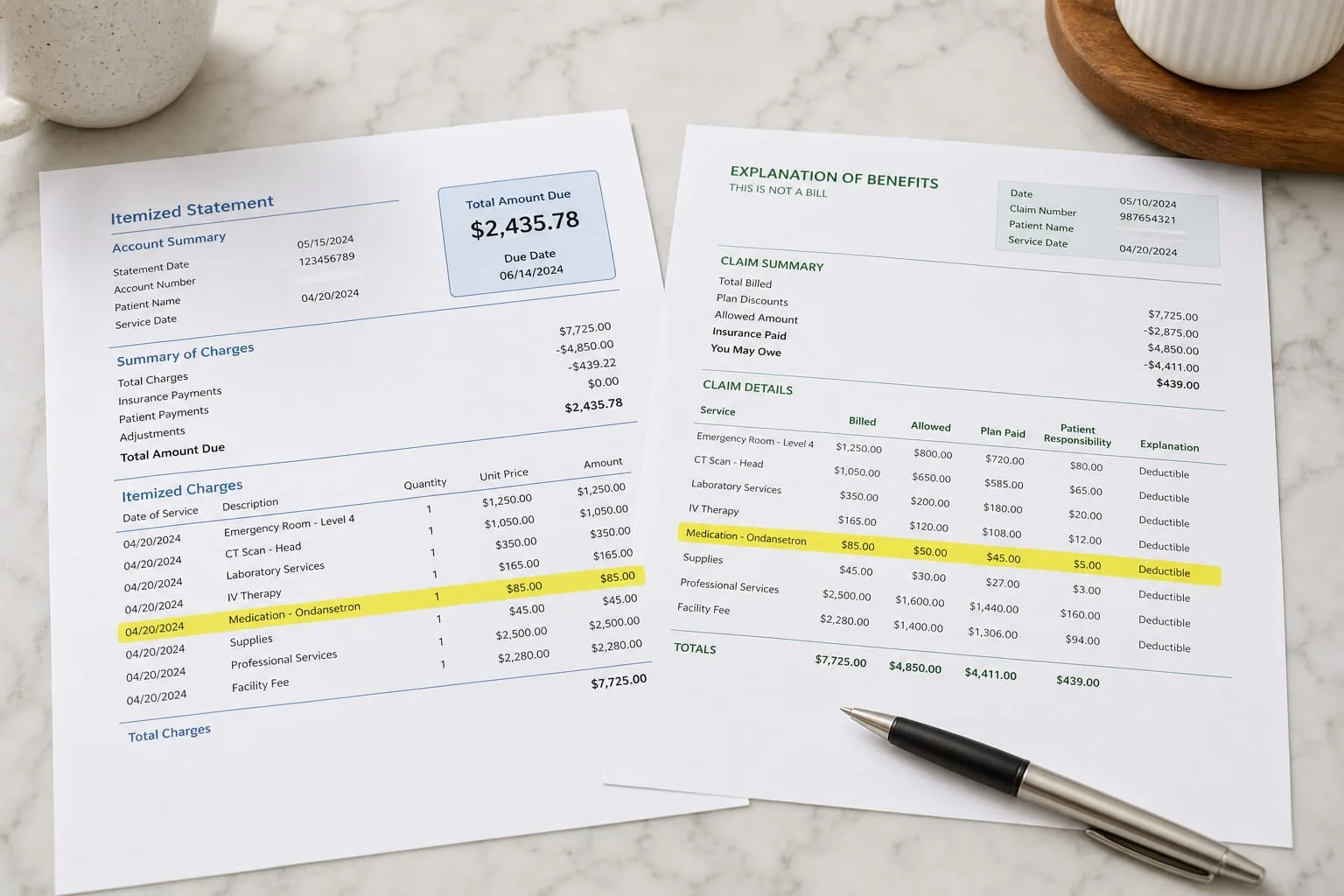
The bill arrived as a single page with four lines on it, none of which described anything the patient remembered happening. She had gone to a clinic in a medical office building for a skin lesion removal, seen a physician she had seen before, and left in under an hour. What came in the mail six weeks later was a summary statement from a hospital system she had never physically entered, followed nine days later by a second statement from a physician group with a different tax identification number. Two bills, one visit, and no obvious relationship between them.
Why the bill you get is a summary and not a record
The document most people call a hospital bill is a customer-service artifact, not the claim. The claim went to the insurer on a standardized form, an institutional claim for the facility and a professional claim for the physician, each carrying procedure codes, revenue codes, modifiers, and diagnosis codes in a structure built for automated adjudication rather than human reading. What the patient receives is a condensed rendering of that claim, collapsed into categories like pharmacy, supplies, and treatment room. The collapsing is deliberate and, in most systems, the default. The underlying detail exists in full and is generally retrievable, but you have to ask for it by name.
That split between the claim and the statement is largely an inheritance. Hospital charge structures grew out of internal cost accounting from an era when almost everything was paid as a percentage of charges, so the master price list expanded line by line, department by department, until it described thousands of billable events with no particular relationship to what anything cost or what any insurer would ultimately pay. Payment moved on to fixed rates and negotiated contracts. The list stayed. The statement you receive is the visible edge of that list, filtered through a contract you never saw.
What the second claim was actually for
In this case the second statement was the one that mattered. The clinic had been acquired by a hospital system some years earlier and converted to what is called a provider-based or hospital outpatient department. Nothing about the waiting room changed. The billing did. Under provider-based rules, a visit generates two claims: a professional charge for the physician's work and a separate facility charge for the room, the staff, the instruments, and the institutional overhead. Insurers pay both. Patient cost sharing applies to both. A visit that would have produced one modest coinsurance amount at an independent office produced a coinsurance amount plus a hospital outpatient deductible.
The Centers for Medicare and Medicaid Services oversees the conditions under which a clinic may bill as a hospital outpatient department, and the rules govern signage, ownership, clinical integration, and how the location is identified on the claim. None of that is a secret. It is simply not communicated in any form that reaches a patient at the point of decision. What the patient in this case had, before the bill, was a building, a doctor, and a copay card. What she had after the bill was a line labeled treatment room on a statement from an entity she had not knowingly chosen.
The part that changes when you cross a state line
Here the story stops being general. Facility fees are federally permitted and locally governed, and the governing has diverged sharply over the last decade. Several states now require hospitals to give written notice before a facility fee is charged at an off-campus location, some require the notice at scheduling and again at check-in, and a handful restrict facility fees for certain outpatient services outright or cap what can be collected from the patient. Other states have done nothing at all, which means the identical visit at the identical corporate system produces a different obligation depending on which side of a county line the office building sits on.
The variation runs deeper than notice. Maryland operates an all-payer rate-setting system, so hospital charges there are established through a state commission rather than negotiated privately, and the arithmetic of a bill looks structurally different as a result. Several states require a hospital to furnish a fully itemized statement on request within a defined number of days, and a few require it automatically. State charity care and financial assistance laws set income thresholds, application windows, and screening obligations that vary widely, and in some states a hospital must screen a patient for assistance before it may refer a balance to collections. Federal law sets a floor for nonprofit hospitals. States build differently on top of it.
Balance billing protections tell the same story. The federal No Surprises Act established a national baseline for emergency care and for out-of-network clinicians at in-network facilities, but roughly two dozen states had already passed their own protections, and those state laws continue to apply to plans the state regulates. Whether your particular plan is state-regulated or a self-funded employer plan governed by federal law determines which rulebook your dispute runs under, and that single fact changes who you complain to, what deadlines bind you, and what the remedy looks like. Most patients do not know which kind of plan they have. The summary plan description says so, usually on the first or second page.
The sequence that resolved it
She asked for the itemized statement in writing, specifying revenue codes, procedure codes, and modifiers, and she asked for both claims, facility and professional, because they come from different billing offices and a request to one does not reach the other. She then set the itemized statement next to the explanation of benefits from her insurer, matching line to line, because the two documents are generated independently and disagreements between them are the most productive thing to find. One supply line on the facility claim had been billed separately from a procedure code that already included it. That was a coding question, not a price question, and coding questions get corrected because the alternative is a claim the insurer can recoup.
The facility fee itself was correct, permitted, and irreducible by argument. What was reducible was the balance, because her state required the hospital to offer financial assistance screening and to hold collections activity while an application was pending, and because the hospital's own posted policy set a discount tier she qualified for and had never been told about. She applied inside the window. The corrected coding removed one line, the discount applied to what remained, and the physician group, billing separately, ran its own smaller version of the same process. Two claims meant two conversations. It also meant two chances.
The useful lesson from this bill is not that hospitals overcharge, which is a claim too broad to act on, but that the document arriving in the mail is a compressed summary of a structured record, and that the rules governing what must be disclosed, itemized, and discounted are written mostly at the state level. Find out what your state requires before you call. The call goes differently when you can name the obligation.