Legal
Quoted a Flat Fee and Still Unsure What It Buys? The Paperwork That Pins It Down
A legal fee quote is a price attached to an assumption about scope. Here are the four documents that make the assumption visible before you sign.
LegalBram Voskuijlen
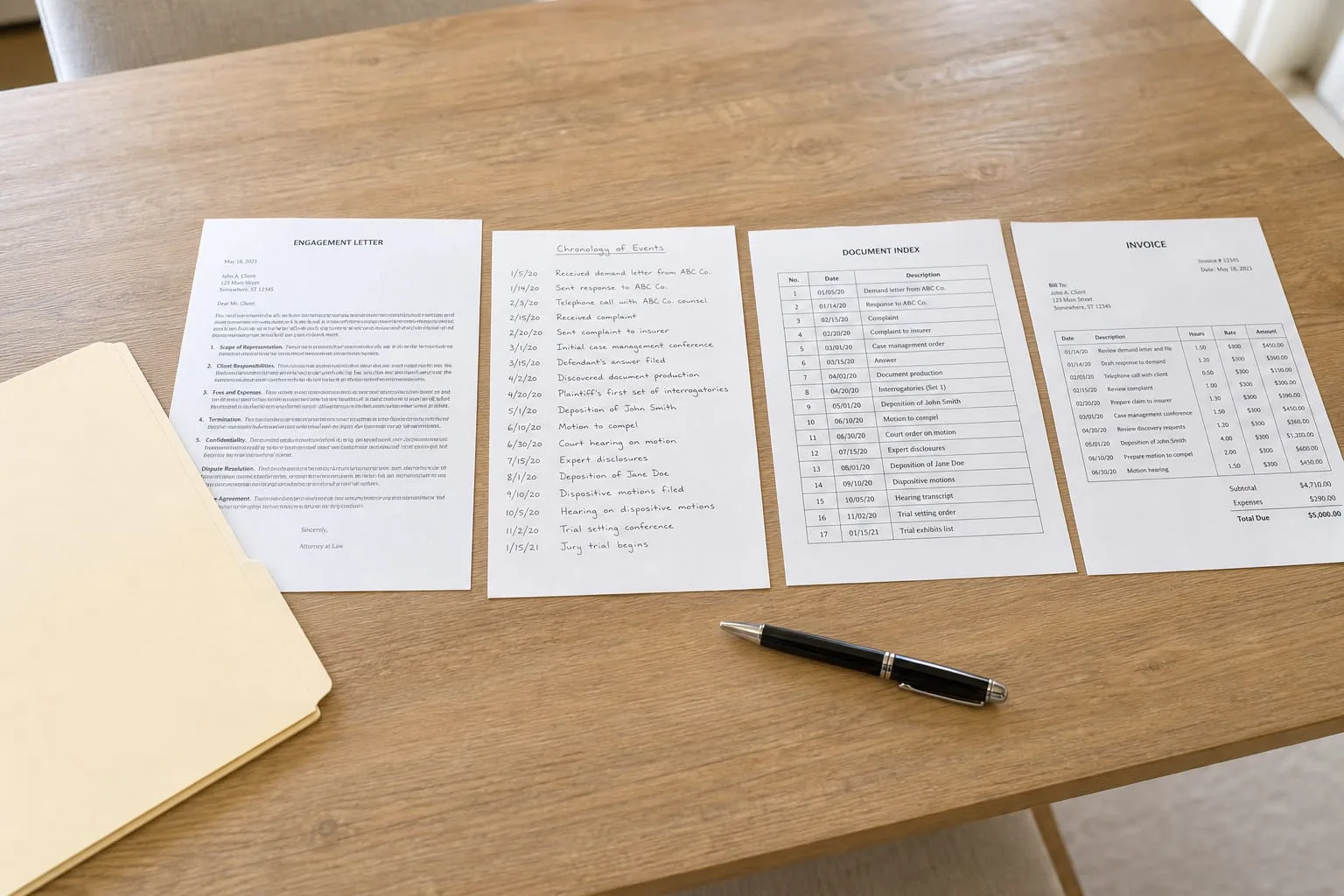
A number arrives by email: a retainer figure, an hourly rate, sometimes a flat fee for handling "the matter." What almost never arrives alongside it is the sentence explaining what the office believes the matter to be, and that sentence is where the money actually lives. Two attorneys quoting an identical figure can be pricing jobs that differ threefold, because one assumed a demand letter and the other assumed a filing, a response, and a hearing. Households rarely have the vocabulary to force that difference into the open, and they do not need it. What they need is three or four pieces of paper, kept somewhere consistent.
Find the unit before you argue about the number
Every quote is built on a unit, and the unit is more informative than the total. Hourly work is billed in increments, usually a tenth or a quarter of an hour, and a quarter-hour minimum turns a two-minute phone call into fifteen minutes of billable time whether or not anyone intended that. Flat fees are quoted against a defined task, not a defined outcome. Contingency percentages can be calculated before costs are deducted or after, which changes what reaches you. Ask which increment applies, which people in the office will touch the file, what each of them bills, whether travel and waiting time are billable, and whether rates rise on a schedule.
Most offices will answer all of that in one email if you ask in one email. The Federal Trade Commission is responsible for how consumer services are advertised and priced in the general marketplace, but the specific rules governing attorney fee agreements are set state by state, through the courts and the state bar, and they vary in what must be written down. That variation is the practical reason to write it down yourself. A quote you can restate in your own words, unit by unit, is a quote you can compare with the next one. A quote you can only restate as a dollar figure is not comparable to anything.
The engagement letter is the quote
Whatever was said on the phone, the engagement letter is the document that governs, and it contains a scope paragraph that most people skim because it reads like boilerplate. It is not boilerplate. It is the fence around the fee. Read it looking for verbs: review, draft, negotiate, file, appear, appeal. If the verbs stop at "negotiate," then litigation is a new engagement at a new price, which may be entirely reasonable, but you should know it before rather than after. Ask for the excluded work to be named explicitly, because an exclusion you can read is a decision you get to make later.
The single most useful question to put in writing is this: what event would make this estimate wrong? Answers tend to be specific and honest. The other side hires counsel. A response deadline gets moved up. A third party refuses to produce a document and has to be subpoenaed. A title issue surfaces that nobody expected. Once those triggers are named, the estimate stops being a promise and becomes a forecast with visible conditions, which is what it always was. Attach the reply to the engagement letter and keep them together in one folder, paper or digital, from the first day.
Costs and fees are two separate ledgers
The fee pays for time or for a task. Costs pay for everything the matter consumes on its way through the system, and they sit on a different line: court filing fees, recording fees at the county, a process server, a court reporter for a deposition, certified copies, records requests, an appraiser, a mediator whose fee is split between the parties, an expert if one is needed. None of that is padding, and none of it is usually inside a flat fee unless the letter says so. A quote that looks complete and omits the cost ledger is not complete.
Two mechanics matter more than the amounts. First, who advances the money: some offices front costs and bill them back, others expect you to pay vendors directly or to fund a cost deposit, and the cash flow differs sharply for a household on a monthly budget. Second, whether you are notified before a cost above some threshold is incurred. Write a number into the engagement letter, whatever number would make you want a phone call, and ask for notice above it. Offices agree to this routinely. It converts surprise into a conversation you can have before the money is gone.
The file you bring is part of the price
Hourly work is quoted against the condition of the record, and the record is the one variable you fully control. Three documents do most of the work. A one-page chronology, dated entries in plain sentences, covering what happened and when. A document index, numbered, with a one-line description of each item and the date it bears. A single paragraph stating what you want to happen, in order of preference, including the outcome you would accept if the best one is unavailable. That paragraph is the hardest to write and saves the most, because it prevents the first meeting from being spent constructing it out loud at an hourly rate.
Then handle the file the way the office does. Scan to PDF rather than photographing paper on a kitchen counter. Name each file with the date first, in year-month-day order, so the folder sorts itself. Keep one running email thread per matter and batch your questions into it, weekly rather than hourly, because five separate emails at a quarter-hour minimum cost more than one email containing five questions. Keep a copy of everything you send. None of this makes you a paralegal. It makes you a client whose matter is cheaper to work on than the identical matter next to it.
Reading the first invoice against what you were told
The first invoice is the moment the quote becomes testable, and it deserves twenty minutes rather than a glance and a payment. Put the engagement letter beside it and match the entries to the scope verbs. Look for block billing, where several hours of mixed activity are described in one line, and ask for itemized descriptions going forward if you find it. Check the timekeeper initials against the rates you were quoted, since work drifting upward to a more expensive person is common and sometimes necessary but should be visible. Ask about anything you cannot connect to a task you recognize.
Then start a tally. A single sheet or a spreadsheet with four columns: date, amount, running total, and the estimate you were given. When the running total crosses roughly two thirds of the estimate and the work is not two thirds done, that is the moment to request a revised estimate in writing rather than at the end. Ask for it as a scope question, not an accusation: what remains, what it is likely to cost, and which of the named triggers has fired. Many state bars also operate fee dispute resolution programs, which exist precisely because reasonable people disagree about scope, and knowing that early tends to keep the conversation practical.
The households that come out of this well are not the ones who negotiated hardest on the rate. They are the ones who arrived with a chronology, an index, and a written statement of what they wanted, then held the invoices against the engagement letter month by month. The fee stops being a mystery figure and becomes a line item with a scope attached, and a line item is something you can plan around, question, cap, or spend deliberately.