Legal
Quoted a Flat Fee and an Hourly Rate for the Same Matter? What Each Measures
Legal quotes used to be a rate. Increasingly they are a price attached to a stage, and the difference decides what your bill looks like in week six.
LegalBram Voskuijlen
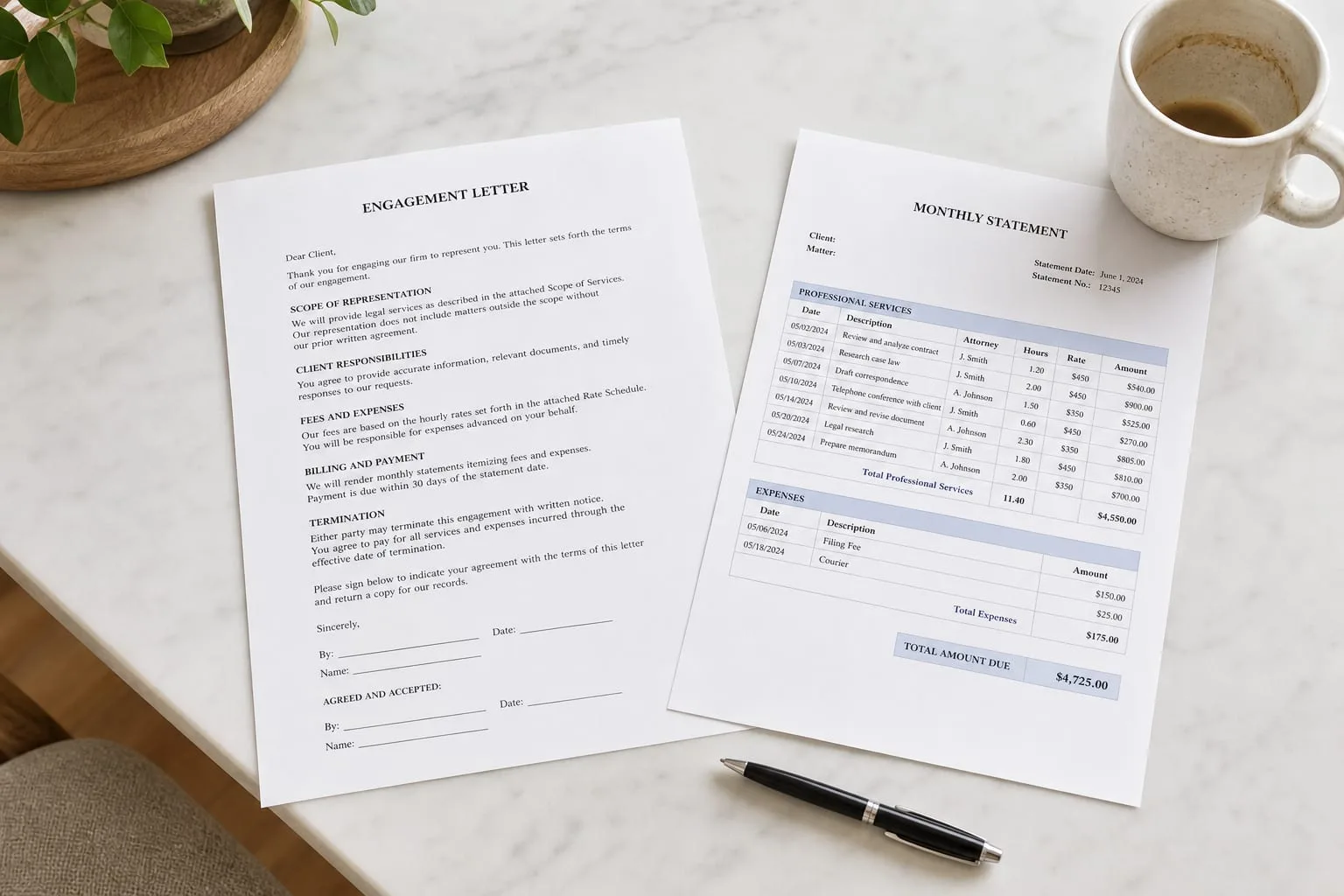
A fee quote from a law office is usually legible in its arithmetic and silent about its unit. You are told a number, and sometimes a range, but rarely told what the number is being measured against: an hour of a specific person's attention, a named document, a stage of a case that ends at a filing, or a result that either arrives or does not. Ten years ago most quotes for ordinary personal legal work resolved to a rate and a retainer, and the client discovered the total later. That has shifted, unevenly, and the shift is worth understanding before you sign anything.
Find out what the number is attached to before you compare two of them
Two quotes for the same matter can differ by half and describe entirely different purchases. An hourly quote is priced against time, which means it is priced against the difficulty of your particular facts, the responsiveness of the other side, and the number of times you call. A flat fee is priced against a defined piece of work, which means the firm has absorbed the risk of your facts being messier than average and has drawn a boundary somewhere to make that bearable. A contingency arrangement is priced against a recovery. When you ask what the fee covers, you are really asking where the boundary sits, and the answer belongs in writing.
The useful question is not "how much" but "what ends this fee." For a flat-fee will package, the fee often ends at signing and does not include a later amendment when a beneficiary changes. For an uncontested filing, it ends when the other party contests. For an hourly matter, nothing ends it except the matter itself, and the estimate you were given is a forecast rather than a cap. Firms answer this question readily when it is asked directly, and the answer tells you more about your eventual bill than the headline rate does.
What a decade changed, and what it did not
The most visible change is that prices are now often published. A decade ago, finding out what a straightforward matter cost usually required a phone call, and the number arrived with a person attached to it. Now many firms post flat fees for defined work: an uncontested filing, a formation package, a review of a lease or a contract. Limited-scope representation, sometimes called unbundling, has become ordinary in many states, so you can buy a document review or a single court appearance instead of the whole case. Client portals and e-filing have taken some administrative time out of the middle of matters, and that time was previously billed.
What did not change is that complex work is still priced against time, because nobody can price uncertainty as a fixed number without either overcharging most clients or losing money on the hard ones. Litigation, disputes with a live opponent, anything involving discovery: these still arrive as rates and retainers. The practical result is a split market. Predictable paperwork has moved toward flat pricing and is easier to compare across firms than it has ever been. Contested matters have not moved, and the skill of reading an hourly engagement letter carefully still matters as much as it did.
The week-to-week reality of an hourly matter
What actually generates an hourly bill is rarely the thing the client was worried about. It is the Tuesday afternoon email answered in six minutes and billed in a tenth or a quarter of an hour, the second call because the first one raised a new question, the document you sent as four photographs that somebody had to assemble into a usable file, and the internal conference between the attorney and the paralegal about which of them handles the next step. Billing increments compound quietly. A matter can run for months at a pace that feels like nothing is happening while the statement grows steadily, because attention is being paid in small units that each round upward.
Retainer replenishment is the other week-to-week fact people are unprepared for. Money held in trust is drawn down against the monthly statement, and when it falls below a floor set in the engagement letter, you are asked to top it up, often on short notice and often at an inconvenient moment. This is normal practice rather than a warning sign, but it is easier to absorb when you have read the trigger in advance and know roughly when it will arrive. Ask for the monthly statement even in a quiet month. A statement you read every month is a bill that never surprises you.
How to hold a quote near the number you were given
Much of what moves an hourly bill is on your side of the table, and it responds to ordinary habits. Batch your questions into one email a week instead of sending five as they occur to you. Nominate a single person in your household or company as the contact, so the firm is not answering the same question twice for two people. Send documents complete, named, and in one file rather than in a trickle. Ask which tasks a paralegal can handle at a lower rate and route those there deliberately. Where the work is genuinely predictable, ask whether the firm will quote that portion flat while keeping the contested part hourly, because many will if asked.
Keep the paperwork with an eye to April as well. Legal fees connected to a trade or business are treated differently from personal ones, and the Internal Revenue Service is responsible for how that distinction works on a return, so an invoice that describes the work in specific terms is more useful to you later than one that says "professional services." Ask the firm to itemize by matter if you have more than one going. It costs nothing at the time of billing and saves an awkward reconstruction months afterward.
The first monthly statement is the real test of a quote. Read it beside the engagement letter, line by line, and ask about anything you cannot place. Firms expect that conversation from clients who are paying attention, and having it in week four is considerably cheaper than having it in month seven.