Legal
A $4,200 Invoice a Client Won't Pay. Five Checks Before You Hire Anyone
For a single unpaid invoice from a former client, five checks decide whether you need an attorney, a demand letter, or a filing fee and one morning in court.
LegalYolanda Escamilla
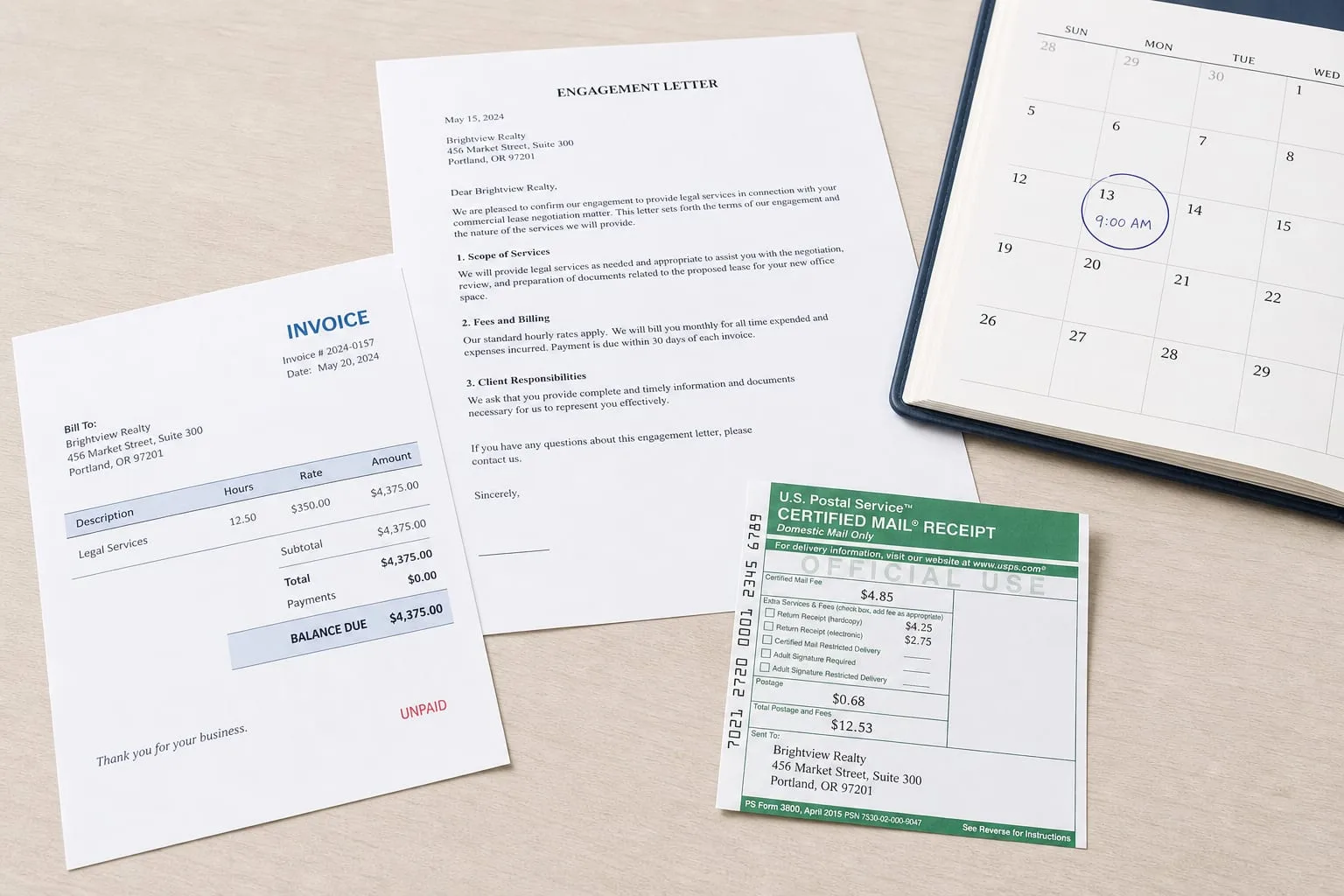
Take a concrete situation, because the general question is unanswerable and the specific one usually is not. A former client owes you $4,200 on two invoices for work delivered eight months ago. Emails go unanswered, the phone rings through, and the last substantive reply said accounting was reviewing it. You are a sole proprietor, you do your own bookkeeping, and every hour you spend on this is an hour you are not billing. The question is not whether you are right. You are. The question is what the recovery costs in hours, appointments and waiting, and at what point paying an attorney buys you something that filing on your own does not.
Check the amount against your county's small claims ceiling
Every state sets a dollar limit on what small claims court will hear, and those limits differ enough that the same dispute is a self-represented filing in one state and a regular civil case one border over. At $4,200 you are almost certainly inside the ceiling somewhere, which matters because small claims is built for people without attorneys: simplified pleadings, relaxed evidence rules, and a judge who expects to hear the story rather than a brief. Some states bar attorneys from appearing in small claims at all. Find your limit on the court's own website before you price anything else, because that single number decides which of two very different cost structures you are in.
If the debt sits just above the ceiling, you have a real choice: waive the excess and file small claims, or move to the general civil docket where the rules, the timeline and the need for counsel all change at once. Waiving a few hundred dollars to stay in the simpler forum is often the cheaper decision once you count your own hours. The general docket does not just cost more in fees. It costs more in appearances, in scheduling that bends around the court rather than around your work, and in the months of low-grade attention a pending case takes from you.
Check the contract for a fee-shifting clause
Nothing in this analysis moves the numbers more than one sentence in your own paperwork. If your engagement letter or terms of service says the prevailing party recovers reasonable attorney's fees and costs, an attorney becomes economically sensible at $4,200, because the fee is no longer coming out of the recovery. Without that clause, the default in most American courts is that each side pays its own lawyer, which means an hourly engagement can consume the judgment it wins. Interest provisions and late-fee terms matter for the same reason. Read the actual document you sent, not the template you meant to send.
This is also the moment to notice what your paperwork will do for you next year, whatever happens here. Contracts with fee-shifting and interest language change how a demand letter lands, because the other side can price its own exposure. If you find nothing, the fix takes an afternoon and applies to every client after this one. That afternoon is the highest-value legal spending in the whole episode, and it is the kind of work an attorney can do on a flat fee in a single sitting.
Check who you would actually be suing, and whether they can pay
A judgment is a piece of paper that says you are owed money. Collecting on it is a separate project with its own filings, its own waiting, and its own trips downtown. So the identity of the debtor matters before you spend anything. A single-member LLC with no assets and a dissolved registration is a different opponent from an operating company with a storefront, a bank account and a business license to protect. Your secretary of state's business search will tell you whether the entity is active, who the registered agent is, and where service can be made.
Entity status also affects the other side's costs, which is leverage. In many states a corporation or LLC cannot appear in court through a non-attorney officer, so a $4,200 claim forces them to retain counsel while you appear for yourself. That asymmetry is why a properly addressed demand letter, sent to the registered agent rather than to the accounts email that has been ignoring you, resolves a meaningful share of these disputes before a filing. It costs a stamp, a certified mail receipt and an hour of drafting.
Check what the self-represented route costs in daytime hours
Filing fees for a claim this size are modest, typically a low three-figure amount, plus a service charge if the sheriff or a process server delivers the papers. The real price is the calendar. Expect a trip to the clerk's window or a careful hour with an e-filing portal, a wait of weeks or months for a hearing date you do not choose, and a morning blocked out for a docket where your case is one of many called. Continuances happen. A defendant who does not appear can produce a default judgment, which is the fast outcome, and then a second sequence of paperwork to enforce it.
Set against that, count the hours you would spend managing an attorney: the intake call, the document handoff, the emails confirming what you already know. Handled yourself, the whole matter is realistically two working days spread across several months. That is a genuine cost, and for some people it is the deciding one, because those days come out of billable time rather than out of savings.
Check whether you need representation or one paid hour of advice
The useful distinction is between hiring an attorney to act and hiring one to tell you what to do. A single consultation at an hourly rate, with your contract, the invoices and the email chain in front of them, answers the questions that actually determine the outcome: whether the clause shifts fees, which court, which defendant, and whether the statute of limitations is anywhere near. Many attorneys will write a demand letter on their letterhead for a flat fee. Some will take a collections matter on a percentage of what is recovered, which changes the arithmetic entirely at this dollar amount.
One more piece of advice belongs in that hour. If the debt proves uncollectable, the tax treatment depends on how you keep your books, and the Internal Revenue Service is the authority on when a business bad debt can be written off at all. Cash-basis sole proprietors, who never recorded the income, generally have nothing to deduct. Knowing that in advance keeps you from spending three hundred dollars chasing a write-off that was never available.
Run the five checks in that order and the decision usually makes itself within an afternoon, before you have paid anyone. The invoice, the contract, the entity record, the court's fee schedule and one calendared morning are the entire file. Keep it in one folder, dated, because whichever route you take, the person who eventually reads it will ask for exactly those five things.